

Solution for Depression
Depression is described differently by almost everyone who experiences it. For some, it is heaviness, a weight that arrives with no clear reason. For others, it is numbness, a blunting of feeling where something used to be. For others, still, it is going through the motions of life while feeling absent from it.
The description varies. What the evidence increasingly shows is that the underlying causes follow recognisable patterns — and that the brain changes associated with depression, while real and measurable, are frequently the body’s response to sustained psychological stress and disconnection rather than the origin of it. Addressing the source, rather than managing downstream effects, enables lasting change.
Key Takeaways
- Depression affects approximately 280 million people worldwide and is the leading cause of disability globally.
- Research identifies seven patterns of psychological disconnection as consistent drivers of depression — and brain changes, while real, are frequently the body’s response to that disconnection rather than its origin.
- Conventional treatments provide important stabilisation for many people, but rarely address the root patterns.
- Integrative hypnotherapy works directly at the root level: with childhood trauma, harsh self-beliefs, loss of meaning, and the relational and existential patterns that sustain depression.
- Reconnection — to meaning, to people, to a genuine sense of self — is where lasting recovery begins.
How significant is depression?
Depression is the second most common mental disorder after anxiety disorders and the leading cause of disability worldwide. Approximately 280 million people live with depression globally, according to the World Health Organization.
Depression can range from mild to moderate to severe. Common symptoms include:
- persistent low mood and loss of pleasure
- reduced self-esteem and self-confidence
- ideas of guilt or unworthiness
- reduced concentration
- disturbed sleep and diminished appetite
In more severe cases, depression can lead to thoughts of self-harm or suicide.
Depression and anxiety disorders frequently co-occur. They share underlying emotional regulation patterns and genetic risk factors. Many people experience both, in different proportions, at different points in their life. Read more about what that means in practice: Mental Health Diagnosis Overlap: What Genetics and Lived Experience Reveal.
What conventional treatment offers
Antidepressants are among the most commonly prescribed treatments for depression. Their purpose is to provide important symptom stabilisation, reducing the acute intensity of low mood to function and engage with other forms of support.
At the same time, antidepressants do not address the patterns that cause and maintain depression. This is why most people need to continue medication long after symptoms improve, and why, when they stop, symptoms often return.
One side effect that is rarely discussed upfront is weight gain. Multiple antidepressants, particularly SSRIs, are associated with a substantial weight gain in a significant proportion of people who take them long-term. For those already dealing with body image concerns or weight-related struggles, this can compound the psychological burden. Read more about what the evidence shows: When Weight Loss Isn’t Just Calories: SSRI-Induced Weight Gain and What the Evidence Actually Shows.
Psychotherapy, including Cognitive Behavioral Therapy, is also widely used and well-evidenced for depression. It works primarily at the conscious, analytical level. For many clients, it produces slow progress and does not reliably prevent the return of symptoms. Read more about how psychotherapy compares to hypnotherapy in efficiency.
The seven roots of depression
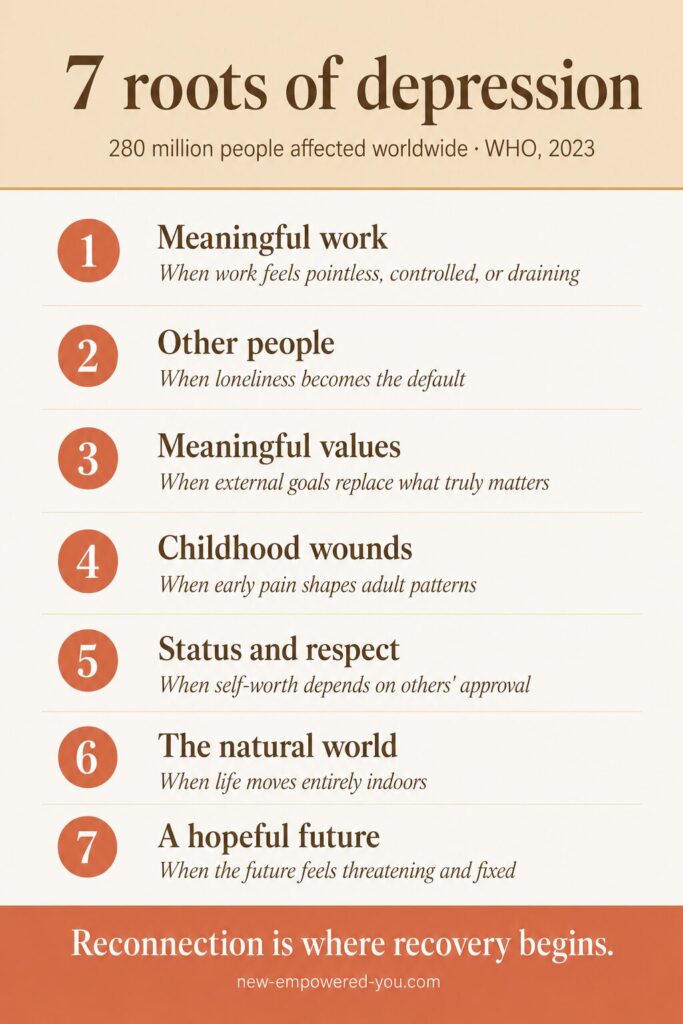
In his widely read book Lost Connections (2018), researcher and journalist Johann Hari synthesised a body of evidence pointing to a different way of understanding depression. Rather than a brain chemistry defect, the research he reviewed identified seven patterns of disconnection from:
- meaningful work
- other people
- values
- childhood
- status
- nature and
- a hopeful future
— as the consistent drivers of depressive experience.
The following decade of research has continued to support and build on this framework. What Hari described as disconnections align closely with what we now understand about the stress-vulnerability model, the ACE (Adverse Childhood Experiences) studies, and the growing literature on social and environmental factors in mental health.
1. Disconnection from meaningful work
Gallup’s ongoing global research consistently shows that the majority of people are disengaged from their work. Work occupies a third of most waking lives. When it feels pointless, controlled, or disconnected from any sense of contribution, it drains energy and self-worth rather than sustaining them.
Research in self-determination theory by Ryan and Deci (Ryan and Deci, 2000) shows that three basic psychological needs — autonomy, mastery, and connectedness — are essential to sustained motivation and wellbeing. Work that violates all three simultaneously is a reliable source of low-grade chronic suffering.
Hypnotherapy helps clients identify what genuinely drives them, separate from the conditioning of what they “should” do. It works with the unconscious fears and beliefs (not being good enough, not deserving a different life) that prevent people from pursuing work with real meaning.
2. Disconnection from other people
Loneliness is one of the most powerful predictors of depression and early death. A landmark meta-analysis by Holt-Lunstad and colleagues (2015) found that social isolation carries a mortality risk comparable to smoking 15 cigarettes a day.
Modern life has made disconnection easier than at any previous point in human history. Physical communities have thinned. Digital communication has expanded reach while often reducing depth. The result is that many people are perpetually in contact yet genuinely alone.
Hypnotherapy addresses the unconscious patterns that sustain this isolation, even when people want connection: shame, fear of rejection, early learning that relationships are unsafe, and the habit of self-sufficiency as a protection against vulnerability.
3. Disconnection from meaningful values
Decades of research by Tim Kasser and Richard Ryan show that people who organise their lives primarily around extrinsic goals — wealth, status, appearance, approval — report lower wellbeing, more anxiety, and more depression than those driven by intrinsic motivations such as relationships, personal growth, and contribution (Kasser and Ryan, 2000).
The culture many of us live in pushes strongly and continuously toward the former. Advertising, social media, and social comparison generate an endless treadmill of achieving and acquiring, that leaves people feeling empty even when they succeed (Sheldon et al, 2004).
Hypnotherapy helps clients identify what they genuinely value beneath the accumulated conditioning. In practice, this surfaces in two recognisable patterns.
Some clients who love their work discover that their low self-worth has been driving them far beyond what is sustainable, fuelled by an exaggerated need for external recognition. Hypnotherapy can replace such a need with a stable, internal sense of self-worth.
Others find the clarity and courage to make professional changes they had long known were right but had not felt free to pursue. Both patterns are commonly observed in clients presenting with burnout.
4. Disconnection from childhood trauma
The ACE (Adverse Childhood Experiences) study, one of the most replicated findings in mental health research, demonstrated that childhood trauma is strongly correlated with adult depression, anxiety, and physical illness. The original study by Felitti and colleagues (1998) found a dose-response relationship: the more categories of adverse experience in childhood, the higher the likelihood of depression and other health problems in adulthood.
The mechanism is not simply memory. Early painful experiences create unconscious beliefs and survival behaviours:
- about whether the world is safe
- whether the person is worthy
- whether others can be trusted
— that continue driving thought, emotion, and behaviour decades after the original circumstances have passed.
Addressing these root patterns is where integrative hypnotherapy does its most direct and powerful work. By accessing the unconscious mind and updating the beliefs and responses formed in childhood, lasting change becomes possible in a way that talking about the past cannot achieve on its own.
5. Disconnection from status and respect
Chronic experiences of humiliation, powerlessness, or being looked down on activate the nervous system’s threat response and, over time, create patterns of depression and anxiety. Robert Sapolsky’s research on social hierarchy and stress hormones (Sapolsky, 2005) and Wilkinson and Pickett’s population-level analysis in The Spirit Level both document the psychological and physiological costs of sustained low-status experience (equalitytrust.org, 2024).
This does not mean depression is only a product of social inequality, though inequality makes it worse. It means that the chronic inner experience of being unworthy, unrespected, or at the bottom of a hierarchy — real or perceived — is depressogenic.
Integrative hypnotherapy cannot change structural inequalities. It can, however, shift the inner relationship from dependence on external validation to a genuine and stable sense of self-worth that is not contingent on others’ approval.
6. Disconnection from the natural world
A 2015 study by Bratman and colleagues found that a 90-minute walk in nature reduced activity in the prefrontal cortex’s rumination circuits compared to an equivalent urban walk. Broader research on green exercise, circadian light exposure, and outdoor movement consistently shows protective effects on mood.
Most modern life is lived indoors, under artificial light, in front of screens. This disrupts the circadian rhythms that regulate sleep, energy, and mood in ways that accumulate quietly over years.
Hypnotherapy cannot replace time spent outside, but it can address motivational patterns that support consistent, mood-sustaining habits.
7. Disconnection from a hopeful or secure future
The perception that the world is dangerous and deteriorating is widespread and by most objective measures, inaccurate. Hans Rosling and his colleagues at the Gapminder Foundation spent years demonstrating, with careful data, that rates of extreme poverty, child mortality, violence, and preventable disease have fallen dramatically over the past century. Their book Factfulness (2018) documents how consistently people across education and income levels hold a catastrophically pessimistic view of global trends.
Information systems are built on negativity bias. Threat-focused media produces a background sense that the future holds nothing good, that security is an illusion, and that trying is futile. This is itself a driver of depression.
Hypnotherapy builds internal security and directs focus to what can be controlled and influenced. It develops present-moment grounding when external chaos is loud. It rewrites the catastrophic thinking patterns with what is genuinely more accurate.
Hypnotherapy for depression: working at the root
Integrative hypnotherapy addresses depression by working directly with the unconscious patterns that maintain it. Where conventional approaches work at the level of conscious reasoning and neurochemical management, hypnotherapy works with the deeper programming: the beliefs about self and world formed in childhood, the survival behaviours that became automatic, and the emotional wounds that never fully resolved.
The goal is not symptom management. It is a genuine reconnection to self-worth, to meaning and purpose, to relationships, to a realistic and liveable sense of the future. That reconnection, sustained by practical lifestyle changes and the brain’s inherent capacity for neuroplasticity, is where lasting recovery from depression begins.
Client’s Testimonial
Before the first session with Olga, I was in a pretty difficult situation. I was in a deep and prolonged depression, because of some big losses I had experienced three years ago. For those three years I was a stay-at-home mom, quite depressed, jobless, and not even being able to look for a job. I was glad that Olga agreed to work with me.
In the very first session going through all my life’s most important and difficult events, I experienced a deep, embodied understanding of the true, better me. Olga has a special talent to touch people in a very sensitive, loving, and healing way. The first session was a strong, irreversible transformational experience.
Transformational audio recordings recorded by Olga, which I listened to every day, strengthened this experience. Olga’s voice is unobtrusive, caring, and personal. Following coaching sessions and discussions with Olga helped me to discern and break from the habits and perceptions that held me back.
After 30 days from the first session I was different — more energy and ideas, like somebody turned a switch in me. I was not only able to apply to different jobs but, most importantly, after getting job offers, I chose the one that best suited my talents and future direction.
I absolutely recommend hypnotherapy and coaching sessions with Olga, because change comes not from reading books, but from deep embodied experience. And with Olga, you are in really good hands.
Lina Metlevskiene, USA
Conclusions
Depression is the second most common mental disorder and the leading cause of disability worldwide. Its roots, as the evidence increasingly shows, lie in disconnection:
- from meaningful work
- from people
- from values
- from early wounds
- from status, from nature
- from a sense that the future holds something worth living toward.
Each of these disconnections can be addressed. Many of them are directly within the territory of integrative hypnotherapy, working at the level of unconscious patterns that keep people stuck.
Reconnection is a practical process, supported by neuroscience.
What is one area of your life where you sense a disconnection — and what would it mean to begin reconnecting there?
FAQ: Solution for Depression
Can you ever fully recover from depression?
Depression is not an inborn state. It develops later in life, often triggered by specific challenging events or circumstances.
Your mind’s primary goal is to secure your survival on this planet. If you encounter unfavorable conditions growing up at home: neglect, violence, abuse — your mind comes up with a survival behavior.
Such behavior becomes an unconscious, automatic program. Typically, a program of low self-esteem, self-blame, and not taking action can lead later in life to depression.
This is only an adaptation of your mind.
If you use therapies that address unconscious behavior, you can achieve rapid, lasting improvements. This is based on neuroplasticity (your brain’s ability to change).
Hypnotherapy is an efficient method to deal with depression and its root causes.
Additional lifestyle changes will support your wellbeing.
Though the purpose of antidepressants is to provide mental stability, they do not address the root cause or cure depression.
My whole family struggles with depression; I know it’s only a matter of time before it hits me, too. Is there any way I can prevent it?
Genetic research confirms that depression has heritable components, which contribute to vulnerability, but aren’t certain predictors. They interact with lived experience, environment, and the patterns of thought and behaviour you have learned.
The most useful question is not “will I get it?” but “what patterns am I carrying, and are they serving me?” Patterns learned in a family environment can be updated. Give yourself reasons why your experience can be different.
Actively building the conditions that protect against depression matters: doing things you genuinely enjoy, maintaining relationships that support you, spending time outdoors, sleeping consistently, and staying physically active. These are the reconnections the research points to.
Is it okay to quit a job that’s making me depressed and anxious?
You take yourself with you wherever you go.
If the patterns driving your stress are internal beliefs about your own adequacy, difficulty with boundaries, and an inability to tolerate uncertainty, the same patterns will appear in the next role.
If, however, the real problem is that you are spending your days in work that holds no meaning for you, the research is clear that sustained disconnection from purpose is a genuine driver of depression. Moving toward work that aligns with what you actually value is worth serious consideration.
What can you do when someone you love is suffering from depression?
Stay in contact. The pull of depression is toward isolation, and your presence matters even when they cannot show it.
Encourage them to take action and to explore treatment options beyond medication alone. Listen without immediately problem-solving. And look after yourself in the process — sustained proximity to someone’s suffering requires your own resources to be tended to.
How do you know you have depression in comparison to a simple period of sadness?
Depression is a diagnosis made by specialists to apply treatment accordingly. Typically, these are antidepressants and psychotherapy (or talk therapy).
As a hypnotherapist, I work with the client’s exact experiences, emotions, and feelings.
Some clients were given a diagnosis but have not experienced sufficient symptom relief during medical treatment, or have stopped taking medication because of weight gain.
Others didn’t seek medical care or receive a diagnosis, even though they had been experiencing depressed moods for an extended period.
Integrative hypnotherapy treats the root cause of their issue holistically, leverages the brain’s ability to change unconscious behavioral programming, and allows clients to achieve fast, permanent relief of their symptoms and improve their overall quality of life.
Do you get more depressed the older you get?
Depression has a certain root cause, like an unconscious negative belief about one’s own unworthiness. The root cause usually originates in childhood, shaped by the environment, by how you were treated, and by how you responded to those experiences.
Such an unconscious negative belief can cause depression already in teenagers or later in life when you face new challenges, and start new phases of your life. But the longer you hold the unconscious negative belief, the more limitations it creates, such as choosing the wrong partners, broken relationships, burnout, and failing careers.
How do I always feel more depressed at night?
Your mind is wired to rest at night. Being wakeful when the body expects sleep makes any person less resilient, and rumination is more active when external demands quiet down.
Your nervous system craves sunshine, is active during the day, and needs rest at night.
You can shift your sleeping routine easily and fast by following the simple rules:
1. View the early morning sunlight going outside for at least 10 minutes
2. Spend time outside during the day as much as possible
3. Stop using artificial upper lights when it turns dark outside, and stop using any screen devices (computer, phone, TV, etc.) at least 2 hours before going to bed.
Learn more here
https://www.new-empowered-you.com/better-sleep/
References
- World Health Organization (2023). Depression. https://www.who.int/news-room/fact-sheets/detail/depression
- Hari, J. (2018). Lost Connections: Uncovering the Real Causes of Depression — and the Unexpected Solutions. Bloomsbury.
- Holt-Lunstad J, Smith TB, Baker M, Harris T, Stephenson D. (2015). Loneliness and Social Isolation as Risk Factors for Mortality: A Meta-Analytic Review. Perspectives on Psychological Science, 10(2), 227–237. https://doi.org/10.1177/1745691615617259
- Felitti VJ et al. (1998). Relationship of Childhood Abuse and Household Dysfunction to Many of the Leading Causes of Death in Adults. American Journal of Preventive Medicine, 14(4), 245–258. https://doi.org/10.1016/S0749-3797(98)00017-8
- Bratman GN et al. (2015). Nature experience reduces rumination and subgenual prefrontal cortex activation. PNAS, 112(28), 8567–8572. https://doi.org/10.1073/pnas.1510459112
- Francis HM et al. (2019). A brief diet intervention can reduce symptoms of depression in young adults. PLOS ONE, 14(10): e0222768. https://doi.org/10.1371/journal.pone.0222768
- Rosling H, Rosling O, Rönnlund AR. (2018). Factfulness. Sceptre.
- Kasser T, Ryan RM. (1993). A dark side of the American dream: Correlates of financial success as a central life aspiration. Journal of Personality and Social Psychology, 65(2), 410–422. https://doi.org/10.1037/0022-3514.65.2.410
About the Author

Olga Willemsen, Ph.D. > Certified Clinical Hypnotherapist & Transformational Coach
Olga Willemsen is the founder of New Empowered You, where she helps clients work through anxiety, burnout, and stubborn weight struggles using an evidence-based, pragmatic approach. She holds a Ph.D. in Natural Sciences and brings that same grounded mindset to her work in advanced hypnotherapy.
A certified member of the International Association of Counselors and Therapists (IACT), Olga trained in RTT, Neo-Ericksonian Hypnosis, and the Simpson Protocol. Her approach works with the mind’s patterns rather than against them, helping clients shift the habits and beliefs that keep them stuck.
Curious what’s really behind what’s holding you back? Let’s find out together.


2 Comments