
When Weight Loss Isn’t Just Calories: SSRI-Induced Weight Gain and What the Evidence Actually Shows About Reversing It
You were slim before the antidepressant. The weight came during treatment, quietly and consistently, despite nothing changing in your eating. You have tried the standard approaches. The weight stayed.
Some of you stopped the medication months or years ago. The scale did not follow. Others are now on a GLP-1 medication and wondering what happens when the prescription ends.
This post maps what the research shows about why this weight behaves differently from ordinary lifestyle weight gain, and which evidence-based approaches give the best chance of sustainable reversal.
Key Takeaways
- Weight gain on SSRIs and SNRIs is driven by specific biological mechanisms (histamine H1 blockade, serotonin receptor downregulation, metabolic set-point shift), not by willpower failure or dietary lapses.
- The average effect is 2 to 5 kg over the years, with wide individual variance; a minority gain 10 kg or more.
- Depression itself contributes to weight gain independent of medication, making the two effects difficult to separate.
- After stopping GLP-1 medications, most of the lost weight returns once both the drug and structured lifestyle support are withdrawn; preserved lean mass is the key protective factor against regain.
- Sustainable reversal requires addressing both the biological upstream (food composition and sequencing, resistance training, sleep) and the psychological patterns that determine whether changes hold.
- Antidepressants produce better outcomes when combined with therapy. Addressing the psychological root cause is part of the treatment picture, not optional lifestyle work.
What most people are told about weight gain
The standard explanation is energy balance: weight equals calories in minus calories out, and any persistent gain reflects a chronic surplus somewhere.
This is a sound principle. But it is incomplete in a way that matters here.
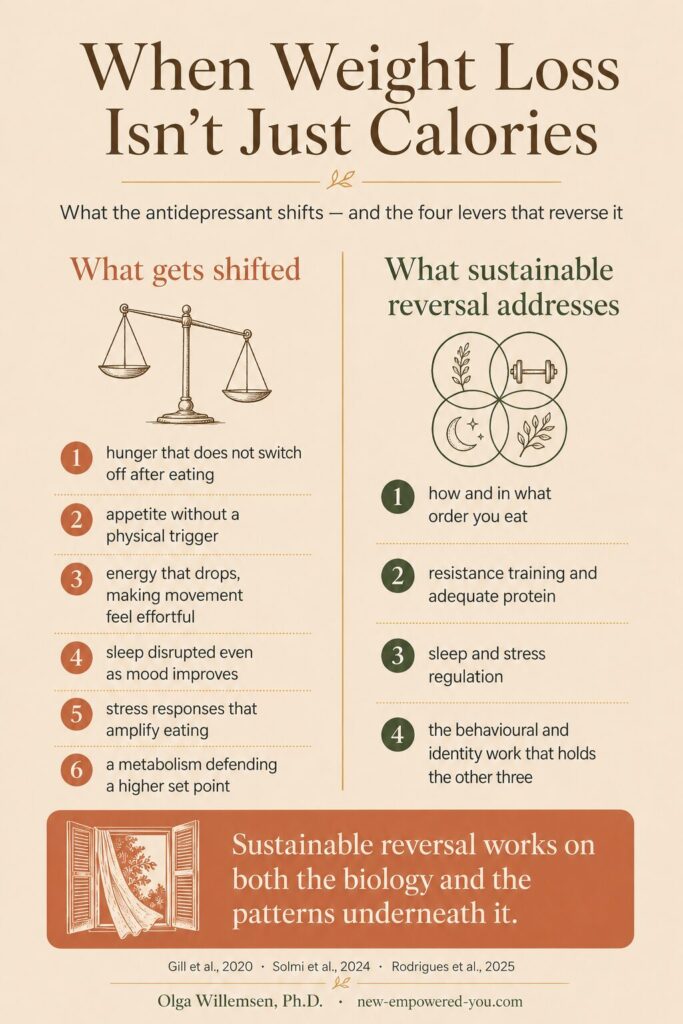
Calories in and calories out are the outputs of an interlocking system. When a medication alters that system, the tally shifts without any deliberate change in eating. The signals that get shifted include:
- hunger that does not switch off after eating
- appetite that arrives without a physical trigger
- energy that drops unexpectedly, making movement feel effortful
- sleep that stays disrupted even as other symptoms improve
- stress responses that amplify the urge to eat
- a resting metabolism slows down
I have written about why the ledger view of metabolism breaks down even in healthy bodies. See Why “Calories In, Calories Out” Fails: The Science Of Metabolic Adaptation. Understanding that argument is the foundation for understanding why antidepressant-related weight gain feels different. It is different. The signals being modulated are upstream of the ledger.
How SSRIs and SNRIs shift weight
Nervous System Modulation
Antidepressants are not a single class. They share a common purpose, modulating nervous system signaling, but they differ substantially in their effects on appetite, satiety, and metabolism. Understanding the mechanism matters because it tells you which experiences belong to which drugs, which are short-lived, and which are structural.
- The strongest single predictor of antidepressant-related weight gain is histamine H1 receptor blockade. Mechanistic reviews consistently identify this as a central driver of increased appetite and reduced energy expenditure across psychotropics, including some antidepressants and many antipsychotics (Gill et al., 2020).
H1 blockade is what makes mirtazapine and the older tricyclics reliable weight gainers.
It is also part of why drugs with narrower serotonin targeting (fluoxetine, bupropion) tend to have smaller weight effects. - The second mechanism is serotonergic, and it acts in two directions. Serotonin at the 5-HT2C receptor in the hypothalamus normally suppresses appetite. SSRIs increase synaptic serotonin, which should dampen hunger, and in some people, especially in the first weeks, it does.
Over months, two things happen: the 5-HT2C receptor downregulates with chronic stimulation, and other serotonergic effects on reward, sleep, and the gut begin to dominate. The result is a gradual unmasking of H1 and metabolic effects (Moss et al., 2025).
This is structural and lasting. - The third mechanism is metabolic in the narrower sense. Some SSRIs and SNRIs appear to reduce resting energy expenditure and alter glucose and lipid handling in ways consistent with a set-point shift rather than simple overeating (Sepulveda-Lizcano et al., 2023).
The clinical signature of a set-point shift is recognizable: the same eating pattern that used to maintain one weight now maintains a higher weight.
Within the class, drugs differ. The most rigorous synthesis is the network meta-analysis by Solmi et al.( 2024), which ranked antidepressants by average weight effect across long-term trials. The familiar clinical pattern held: paroxetine (Paxil) and mirtazapine at the higher end, fluoxetine and bupropion (Wellbutrin) at the lower end, sertraline (Zoloft) and escitalopram (Lexapro) in between.
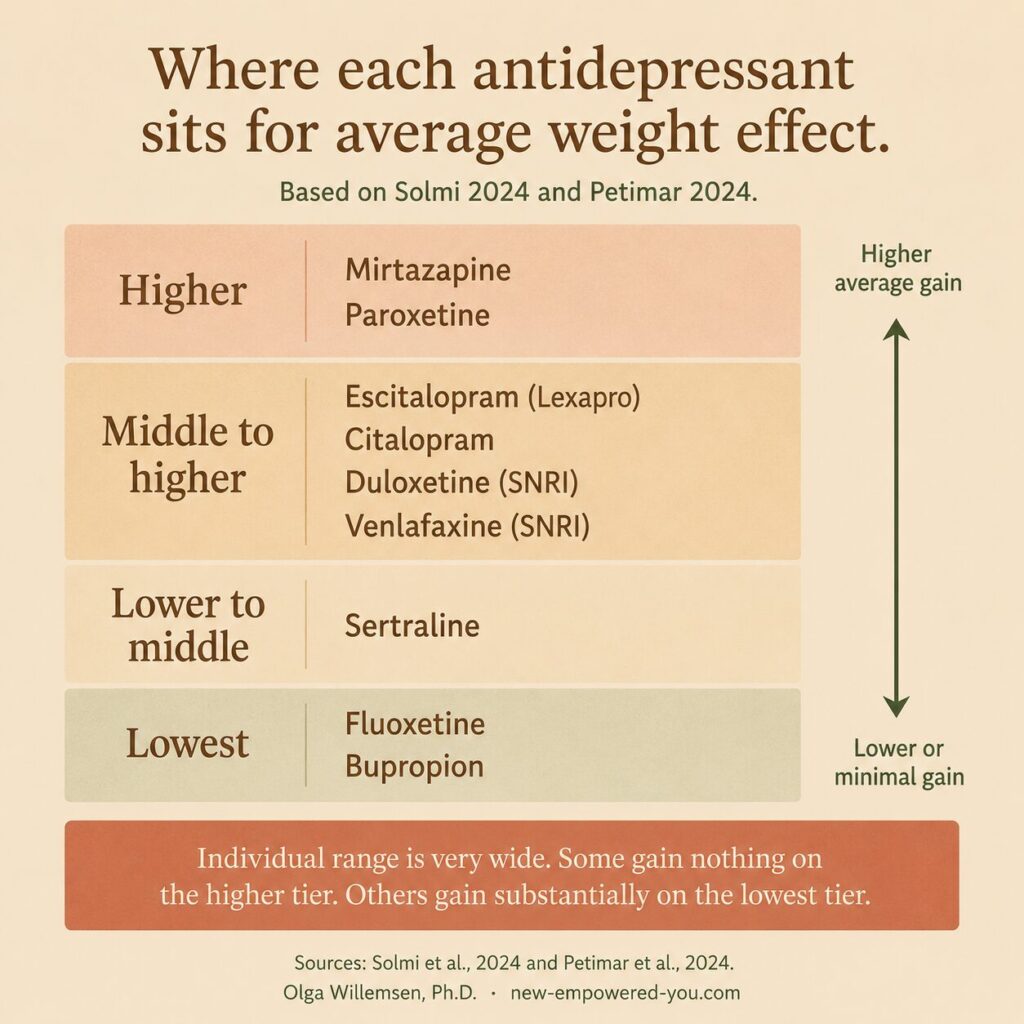
The average effect for the higher-weight drugs is in the range of two to four kilograms over a year or more, with very high individual variance. The drug class explains part of the variance. The rest comes from individual biology.
Three clinical points
First, early weight change is a signal. The gain in the first month of SSRI treatment is one of the strongest available predictors of greater weight gain over the following year (Solmi et al., 2024). Average trajectories show weight rising through months six to twelve and stabilising above the pre-treatment baseline at around six months.
Early gain is worth raising with your prescriber before patterns become entrenched.
Second, weight effects are partially independent of dose. Small doses can produce noticeable shifts. Large doses may produce no additional effect. This reflects receptor occupancy curves rather than a linear dose-response.
Third, the weight is the most visible part of a broader metabolic story. Antidepressant-related weight gain is associated with measurable changes in lipid profiles, glucose handling, and incident metabolic risk in some users (Patel et al., 2022; Scheen, 2023).
Pharmacovigilance data show that women and younger users appear disproportionately in adverse-event reports for antidepressant-related metabolic effects (Cao et al., 2025).
Tracking weight alone misses what is happening beneath the surface. The conversation worth having with your prescriber covers fasting glucose, HbA1c, lipids, and blood pressure at intervals during the first year or two of treatment.
Depression itself: the layer underneath
There is a confounder that good research takes seriously.
Depression itself, untreated, is associated with weight changes.
Sleep disturbance, reduced movement, anhedonia, and emotional eating are downstream consequences of depression that cluster with weight gain before any medication is started. The longitudinal Lausanne data (Strippoli and Preisig, 2024) show this clearly: depression at baseline predicts weight gain at follow-up, independent of treatment. Some of what looks like “the SSRI did this” is the depression trajectory, with the medication’s effect layered on top.
This matters for how you hold the experience. The weight arrived during a period of treatment you needed. The medication’s contribution is real but typically modest. The depression’s contribution is also real. And the return of appetite, pleasure in food, and social eating is part of what recovery looks like, even when it shows up on the scale.
What the long-term data show
Across long-term cohort studies, on average, adults gain roughly 2 to 5 kilograms over 5 to 10 years on an SSRI. Individual response varies widely, from no gain at all to more than ten kilograms. There is also a clear drug-by-drug gradient (Gafoor et al., 2018; Lassale et al., 2024; Petimar et al., 2024; Strippoli and Preisig, 2024).
The large UK primary-care cohort by Gafoor and colleagues, over 130,000 adults followed for a decade, reported a roughly 21% increased risk of meaningful weight gain (5% or more of body weight) in long-term antidepressant users, with elevated risk persisting for at least six years. The recent Petimar analysis adds drug-level detail: escitalopram (Lexapro), paroxetine (Paxil), duloxetine (Cymbalta), and venlafaxine (Effexor XR) were associated with somewhat greater long-term gain than sertraline (Zoloft); bupropion (Wellbutrin) with less.
Where each antidepressant sits for average weight effect
| Antidepressant | Average weight effect | Notes |
|---|---|---|
| Mirtazapine | Higher | Strong histamine blockade. Often a reliable weight gainer. |
| Paroxetine (Paxil) | Higher | Highest among common SSRIs in long-term cohorts. |
| Escitalopram (Lexapro) | Middle to higher | Widely prescribed. Sits above sertraline in long-term data. |
| Citalopram | Middle to higher | Close to escitalopram. |
| Duloxetine (Cymbalta, SNRI) | Middle to higher | Long-term gain trend in cohort data. |
| Venlafaxine (Effexor XR, SNRI) | Middle to higher | Long-term gain trend in cohort data. |
| Sertraline (Zoloft) | Lower to middle | Sits below escitalopram in long-term data. |
| Fluoxetine | Lower | Consistently at the low end. |
| Bupropion (Wellbutrin) | Lowest | Often weight-neutral or slight loss. Favorable glucose effects. |
SSRI-induced weight-gain patterns
Several patterns recur. Weight effects are larger with more H1-antagonist activity, larger when treatment continues beyond a year, and smaller (sometimes negligible) when the underlying depression resolves quickly and treatment is short.
The cohorts also identify who is most likely to gain.
- Pre-existing overweight, metabolic syndrome
- a sedentary lifestyle, and
- higher symptom severity at the start of treatment
– consistently predict larger weight effects (Moss et al., 2025; Solmi et al., 2024). People whose metabolic baseline is already strained tend to show the largest additional shift.
The clinical implication is direct: for someone with these risk factors, lifestyle support from the first weeks of treatment is the most evidence-supported way to change the trajectory before it sets in.
Two further things stand out.
First, the average figures hide a wide distribution:
- A sizeable minority of patients gain little or nothing;
- A sizeable minority gains 10 kilograms or more.
Mean values understate the experience of those who gain significantly.
Second, the long-term cohorts cannot fully separate the medication effect from the recovery effect from baseline depression. The most cautious reading is that
- some of the weight is attributable to the medication
- some to depression and its recovery, and
- some to lifestyle changes during the same period.
If you have gained more than the population average, you are in the upper end of a wide distribution.
Your experience is real and consistent with what the research describes.
The GLP-1 question
A growing number of people arriving with antidepressant-related weight gain are either on a GLP-1 receptor agonist (semaglutide, liraglutide, tirzepatide) or considering one. The question most want answered is what happens when the medication ends.
The clearest evidence comes from the STEP-1 extension trial of semaglutide. Participants who had lost an average of about 17.3% of body weight regained roughly two-thirds of that loss in the year after withdrawal of both the drug and the structured lifestyle program. Their weight at week 120 was still below baseline, with a net loss of around 5.6% sustained (Wilding et al., 2022).
Most of the weight loss returns. Regain stops below the original starting weight.
The SURMOUNT-4 tirzepatide withdrawal trial tells a similar story: substantial regain after stopping; maintained loss with continued treatment (Aronne et al., 2024).
The SELECT cardiovascular outcomes trial adds important context: the cardiovascular benefits of semaglutide in people with established disease accrue over years of continued use (Lincoff et al., 2023).
Real-world data, still maturing, suggest that regain is heterogeneous and shaped strongly by what happened during the medication phase, particularly:
- whether muscle mass was preserved and
- whether durable behavioral changes were established (Mozaffarian et al., 2025).
The people who end up worse off tend to be those who lost muscle mass on the drug and regained predominantly fat after withdrawal. The scale misses this shift entirely.
The accurate statement is: most of the loss returns once treatment and structured lifestyle support both stop.
What protects against regain is the durability of the behavioral and lifestyle changes built during treatment, above all, the preservation of lean mass.
What works
When clients ask what they can do, the honest answer is that there is a stack of evidence-based approaches that work in this population. None is dramatic individually. Several are powerful in combination. The literature on behavioral weight management in adults is well-established (Elmaleh-Sachs et al., 2023; Gudzune and Kushner, 2024). Here is what the evidence supports.
HOW YOU EAT, NOT JUST HOW MUCH
Meal composition (protein-forward, with attention to glycaemic load) and the order in which foods are eaten meaningfully shift the post-meal glucose and satiety responses, even when total calories stay the same. I have written about this in detail in How Food Sequencing For Weight Loss Changes Your Biology.
For someone whose appetite signaling has been altered by medication, eating in a way that gives the satiety system its strongest possible signal (protein and fiber before refined carbohydrate, slower meals, food before alcohol) is one of the most underrated and evidence-supported interventions available. It is free, repeatable, and independent of any medication decision.
RESISTANCE TRAINING AND ADEQUATE PROTEIN
During any period of intentional weight loss, and especially during or after GLP-1 treatment, the risk is preferential loss of lean mass. Two to three weekly resistance sessions and daily protein at the higher end of the standard adult range protect lean mass and improve metabolic flexibility independent of weight change. This is unusually important here: post-SSRI and post-GLP-1 are precisely the cases where preserving lean mass changes long-term outcomes.
SLEEP AND STRESS REGULATION
Both are mechanistically upstream of appetite and energy expenditure. Both are commonly disrupted by depression, by SSRIs themselves, and by the circumstances that brought someone into treatment.
Improving sleep architecture (consistent timing, light management, cooler room temperature, reduced alcohol intake) engages several of the same hormonal levers that medications act on: ghrelin (hunger hormone), leptin (satiety hormone), and cortisol.
Stress regulation, any reliable practice that reduces sympathetic arousal, has independent effects on emotional eating and visceral fat distribution.
THE BEHAVIOURAL AND IDENTITY WORK THAT MAKES THE OTHER THREE SUSTAINABLE
This is where the research is clear and where it is most often underweighted. The clinical literature on antidepressant-related weight gain consistently shows that structured psychological intervention belongs in the picture from the start.
The interventions with the strongest empirical support in this population are cognitive-behavioral therapy and motivational interviewing, both of which improve adherence to dietary and activity changes during antidepressant treatment (Mouawad et al., 2025; Solmi et al., 2024). People managing weight on antidepressants consistently report that psychological support (rather than dietary advice alone) is what makes the difference (Rodrigues et al., 2025).
This is also where my practice sits. One point from the treatment literature is worth stating before getting into the evidence: antidepressants produce better outcomes when combined with psychological therapy than when used alone. The combined-treatment literature is consistent on this across populations and guidelines. The implication matters for anyone who has addressed the medication side of the equation and not the psychological side: part of the picture remains unaddressed.
Hypnotherapy’s role here is broader than lifestyle support.
An integrative approach works on the root causes that brought someone into treatment:
- the stress responses
- emotional patterns
- sleep disruption
- identity-level beliefs
– that both precede and sustain a depressive episode. This is a different claim from “hypnotherapy helps with dieting.” It is about addressing the upstream conditions that made antidepressants necessary.
A note on the evidence.
The research literature on psychological therapies is dominated by cognitive-behavioral therapy. CBT is easy to standardize, manualize, and fund in large trials; hypnotherapy is harder to study at scale. Absence of large RCTs reflects the research ecosystem, not the clinical record. Most of the population-level evidence on psychological therapy covers CBT because that is where the funding has gone, not because other approaches are less effective in practice.
What the evidence base does include for hypnotherapy: moderate-quality support as an adjunct in weight management (Milling et al., 2018), and a substantial mechanism-based literature on the role of stress reactivity, emotional eating patterns, sleep, and identity-level beliefs in determining whether lifestyle changes hold.
An integrative hypnotherapy approach targets those mechanisms, regardless of diagnosis. It sits alongside the more conventional behavioral therapies, and that is the lane in which it holds up, clinically and in the published evidence. See Hypnotherapy for Weight Loss for more on the approach.
What integrates the four levers is consistency over months, not effort for weeks.
Almost all the failure modes documented in the behavioral weight management literature come from approaches that work for six weeks and cannot be sustained. The aim is the opposite: practices small enough to maintain, repeated long enough to become identity.
Open questions
Several clinically important questions remain open:
- Who gains and who does not, and why, remain unpredictable at the individual level. Some genetic, microbiome, and metabolic predictors are emerging in cohorts, but none are yet actionable in clinical practice.
- The long-term durability of GLP-1 effects, combined with structured behavioral support, is too new to make confident statements.
- Whether intentional weight loss in patients on antidepressants meaningfully increases relapse risk is reassuring in small studies but deserves larger trials.
- Which behavioral interventions work best in this specific subgroup, and in which sequence, is a question almost no funded trial has addressed at scale.
- And the role of the gut microbiome, altered by both depression and SSRI use, is a plausibly important mediating layer that research is only beginning to map.
None of these gaps invalidates the practical guidance above. They mean the guidance is best applied with attention to individual response.
A reflection
You have carried weight that arrived during treatment. The calorie ledger did not explain it. The standard advice did not move it.
What changes the picture is addressing both the biological upstream (how you eat, how you move, how you sleep) and the psychological patterns that determine whether any of it holds.
Which of the four levers above has had the least attention in the last year? That is usually where the most ground is available.
At New Empowered You, this is the work I do with clients:
addressing the body and the patterns that shape it, together.
Book a complimentary consultation, and we will look at your specific situation.
FAQ: SSRI Weight Gain Reverse
How long after starting an SSRI does weight typically begin to shift?
The largest weight changes usually appear in months six to twelve, with average trajectories stabilizing above baseline at around six months (Moss et al., 2025; Solmi et al., 2024). The most underappreciated finding is that early weight change matters: gain in the first month of treatment is one of the strongest available predictors of larger long-term gain (Fava, 2000). The first month is a signal, and it is worth raising with your prescriber early, before patterns set.
Does weight gain on antidepressants mean the dose is too high?
Weight effects and dose follow different curves. They reflect receptor occupancy in histaminergic and serotonergic pathways rather than a simple pharmacokinetic dose-response relationship. Small doses can produce noticeable shifts; large doses may produce no additional effect. This is a question for your prescriber.
Is the weight gain truly from the medication, or is it from depression recovery?
Both, and the proportions vary by person. Cohort data, including the long-term Lausanne work (Strippoli and Preisig, 2024), show that depression itself is associated with weight changes independent of treatment. The medication’s contribution is real but typically modest on top of that. The cleanest reading is that the medication explains some of the variance, depression and recovery explain some, and lifestyle context fills in the rest.
If I lose weight while still on antidepressant, will it come back?
Weight changes during antidepressant treatment are not a one-way ratchet. People do successfully reduce weight on stable medication, particularly when the four lifestyle levers above are addressed together. The literature on behavioral weight management (Elmaleh-Sachs et al., 2023; Gudzune and Kushner, 2024) is generally applicable in this population, with lean mass preservation playing an even more important role here than in the general adult population.
What about combining the GLP-1 treatment with antidepressants?
This is an active area of clinical practice and research, and the answer for any individual depends on the indication, history, and interaction profile. Those questions belong with the prescribing clinician. The behavioral and lifestyle work that produces durable change is the same regardless of the medication combination: protein-forward, glucose-aware eating; resistance training; sleep; stress regulation; and the deeper work of shifting the underlying eating and stress patterns.
Are there genetic or microbiome predictors of who will gain weight on SSRIs?
Several candidate predictors are emerging in the research literature, including variants in genes related to serotonin receptor function, baseline microbiome composition, and baseline metabolic markers, but none are yet actionable in clinical practice. The most reliable population-level predictors remain the drug class, treatment duration, and baseline BMI. At the individual level, the best information comes from observing your own response in the first six to twelve months and adjusting with your clinician.
Does Lexapro cause weight gain?
Yes. Long-term cohort data show that Lexapro (escitalopram) carries a modest average weight gain over 1 to 5 years of treatment (Petimar et al., 2024; Solmi et al., 2024). The average sits in the two- to four-kilogram range, with a wide individual spread. Some people gain nothing. Others gain more than ten kilograms. Lexapro sits in the middle of the SSRI ranking for weight effect: higher than sertraline, bupropion, and fluoxetine, lower than paroxetine and mirtazapine.
How much weight do people gain on Lexapro on average?
Long-term cohort data put the average at roughly two to four kilograms over one to five years on Lexapro, with a very wide individual range from no gain at all to more than ten kilograms (Petimar et al., 2024; Gafoor et al., 2018). Reports of thirty-pound gains are real for a minority of users, especially those with pre-existing obesity, metabolic syndrome, a sedentary lifestyle, or more severe symptoms at the start of treatment. Mean numbers understate the experience of those at the upper end of the distribution.
When does Lexapro weight gain start, and when does it stop?
The most useful window is the first month. Weight change in the first month of Lexapro treatment is one of the strongest predictors of a larger gain over the following year (Fava, 2000; Solmi et al., 2024). Average trajectories rise through months six to twelve, then tend to stabilize around six months above the pre-treatment baseline. Weight rarely continues to climb indefinitely, and a plateau is common. Reversal usually requires a change in what you are doing, or a change in the medication itself.
Is Lexapro weight gain permanent, or does it go away after stopping?
Some of the weight comes off after stopping. Some stays. Cohort follow-up suggests that people who used Lexapro for less than a year, whose depression resolved quickly, and who kept a stable eating and movement pattern during treatment, are more likely to return close to baseline. Those who used it for several years, who gained substantially, or who lacked lifestyle scaffolding during treatment are more likely to carry part of the weight forward. Full reversal is possible for some, and it responds to the same four levers described in this post: how you eat, resistance training and protein, sleep and stress, and the psychological work that keeps changes in place. Decisions about tapering belong with your prescriber.
Is SSRI weight gain dose-dependent?
Only weakly. Weight effects on SSRIs reflect how strongly the medication occupies histamine and serotonin receptors, which is closer to a switch than a slider. Small doses can produce meaningful shifts. Higher doses often add little extra weight on top of that. Some people gain on 5 mg of Lexapro, others gain the same on 20 mg, and others gain nothing on either. This is why dose questions belong with the prescriber rather than with an online dose chart.
Do women gain more weight than men on SSRIs?
Real-world pharmacovigilance data show that women, especially younger women, appear more often in adverse event reports for antidepressant-related weight and metabolic effects (Cao et al., 2025). Part of this reflects real biological differences (hormonal cycling, body composition, receptor sensitivity). Part reflects reporting patterns (women are prescribed SSRIs more often and report side effects more often). The clinically useful takeaway is that women benefit from tracking early weight changes on Lexapro and other SSRIs and raising them with the prescriber early, before patterns set in.
Is SSRI weight gain a myth?
SSRI weight gain is real, and the evidence base is now large and consistent. A UK cohort of over 130,000 adults followed for a decade found roughly a 21% higher risk of meaningful weight gain in long-term antidepressant users compared with non-users, and the elevated risk persisted for at least six years (Gafoor et al., 2018). Network meta-analysis of trials confirms class differences between antidepressants (Solmi et al., 2024). Some people gain nothing, which is real. Others gain substantially, which is also real. Both belong to the same distribution.
People Also Ask: SSRI-Induced Weight Gain Reverse
Can you lose weight while on antidepressants?
Yes. The weight effects of SSRIs and SNRIs are real but typically modest, and they are smaller than the combined effect of consistent lifestyle changes (protein-forward eating, food sequencing, resistance training, sleep, and stress regulation). People successfully reduce weight on stable antidepressant treatment in both clinical practice and the published behavioral weight management literature. The weight effect of the medication is a headwind, not a wall.
Why is it so hard to lose weight on SSRIs?
Because the medication has shifted upstream signals, including appetite, satiety, basal energy expenditure, and sleep architecture. The standard calorie-deficit approach addresses the ledger without addressing the regulatory system that drives it. Recent qualitative research on adults managing weight on antidepressants captures this directly: people consistently describe it as meaningfully harder than weight management off these medications, and report that structured psychological support (CBT, motivational interviewing, or other behavioral work) alongside the dietary changes is what makes the difference (Rodrigues et al., 2025). Approaches that shift the upstream signals (meal composition and sequencing, lean mass preservation, sleep regularisation, behavioral work on emotional eating) tend to be more effective than deficit-only strategies.
Will I lose weight after stopping antidepressants?
Some people return to their pre-treatment weight in the months after stopping; some do not. The likelihood of full reversal depends on how long the medication was used, which medication it was, baseline BMI, and what behavioral patterns became established during treatment. The lifestyle work that supports return to baseline is the same work that supports reduction during treatment.
What antidepressants cause the least weight gain?
According to the most recent network meta-analysis (Solmi et al., 2024) and recent long-term cohort comparisons (Petimar et al., 2024), the consistent pattern is: paroxetine and mirtazapine at the higher end of average weight effect; escitalopram, citalopram, duloxetine, and venlafaxine in the middle; sertraline lower; bupropion and fluoxetine at the lowest end, with bupropion also associated with more favourable effects on glycaemia. Important qualifier: average effects mask very high individual variance, and the right antidepressant for any person depends on far more than weight. Efficacy for the underlying condition, side-effect profile, interaction history, and personal response all matter more. This is a conversation for your prescriber.
Does hypnotherapy help to lose weight after antidepressants?
There are no large randomized trials of hypnotherapy specifically in people with antidepressant-related weight gain. That is a real gap. What exists is moderate-quality evidence that hypnotherapy supports weight management as an adjunct to standard behavioral interventions (Milling et al., 2018), and a much larger mechanism-based literature supporting its role in addressing emotional eating, stress reactivity, sleep, and the identity-level beliefs that determine whether lifestyle changes hold. An integrative hypnotherapy approach is a way of working on those mechanisms, independent of any diagnosis.
Can you take Ozempic or Zepbound while on Lexapro or another SSRI?
Current labels for semaglutide (Ozempic, Wegovy) and tirzepatide (Zepbound, Mounjaro) permit combination with SSRIs, including Lexapro, and clinicians increasingly consider the combination for patients whose weight gain on the antidepressant has become a serious issue. Whether the combination is right for you is a prescriber’s question that depends on your history, mental state, cardiovascular status, and the trade-offs your prescribing clinician weighs. The behavioral work stays the same either way: protein-forward eating, resistance training, sleep, stress regulation, and the psychological work that keeps changes in place.
Does switching to bupropion (Wellbutrin) reverse SSRI weight gain?
Bupropion sits at the low end of the antidepressant weight-effect spectrum and carries more favorable effects on glucose handling (Petimar et al., 2024; Solmi et al., 2024). Switching from an SSRI to bupropion, or adding bupropion, is a real clinical strategy that some prescribers use when weight gain has become a significant issue, and bupropion is otherwise appropriate for the person’s mental health picture. It suits some patients more than others, and the decision sits with the prescriber. Weight response after a switch varies, and lifestyle scaffolding remains essential.
Does metformin help with SSRI weight gain?
Metformin has been studied for medication-related weight gain, mostly in the context of antipsychotics, where the evidence for modest weight reduction is moderate. Evidence for metformin specifically for SSRI-related weight gain in adults without diabetes is thinner and less consistent. Some clinicians consider it in patients with insulin resistance or established metabolic syndrome, where the evidence base is stronger. This is a prescriber conversation, and the decision belongs with them.
Which SSRI causes the most weight gain?
Across long-term cohort studies and network meta-analysis, paroxetine sits at the high end of the SSRI class for average weight gain, followed by escitalopram (Lexapro), citalopram, and, among SNRIs, duloxetine and venlafaxine. Sertraline sits lower. Fluoxetine and bupropion sit at the lowest end (Solmi et al., 2024; Petimar et al., 2024). Mirtazapine, technically a different class but often grouped in these discussions, sits at the higher end. Average effects mask substantial individual variation, and the right medication depends on far more than weight.
About the Author

Olga Willemsen, Ph.D. > Certified Clinical Hypnotherapist & Transformational Coach
Olga Willemsen is the founder of New Empowered You, where she helps clients work through anxiety, burnout, and stubborn weight struggles using an evidence-based, pragmatic approach. She holds a Ph.D. in Natural Sciences and brings that same grounded mindset to her work in advanced hypnotherapy.
A certified member of the International Association of Counselors and Therapists (IACT), Olga trained in RTT, Neo-Ericksonian Hypnosis, and the Simpson Protocol. Her approach works with the mind’s patterns rather than against them, helping clients shift the habits and beliefs that keep them stuck.
Curious what’s really behind what’s holding you back? Let’s find out together.