
The Prediction Machine: What Neuroscience Reveals About How Hypnotherapy Really Works
There is a pattern I encounter regularly in my practice, and it never ceases to be striking. A person arrives who understands, with complete clarity, what needs to change:
They know that eating late at night is not hunger.
They know the loop of self-criticism is distorting rather than motivating.
They have read the books, tried the plans, and understood the logic.
And yet the behavior keeps happening. Not because they lack intelligence, and not because they lack motivation. Because their brain is running a program that conscious intention has very little power over.
That program is not a reaction to what is happening around them. It is a prediction.
This matters enormously for understanding how lasting change actually works and why hypnotherapy, approached as a serious clinical tool, can reach what advice, willpower, and even conventional therapy often cannot. The reason comes down to a fundamental property of the brain that neuroscience has only begun to formalize in the last two decades, though practitioners have been working with it for much longer.
Key Takeaways
- The brain predicts before it acts. Karl Friston’s predictive processing framework establishes that the brain continuously generates an internal model of what is about to happen. Behavior runs from this model, not from conscious intention.
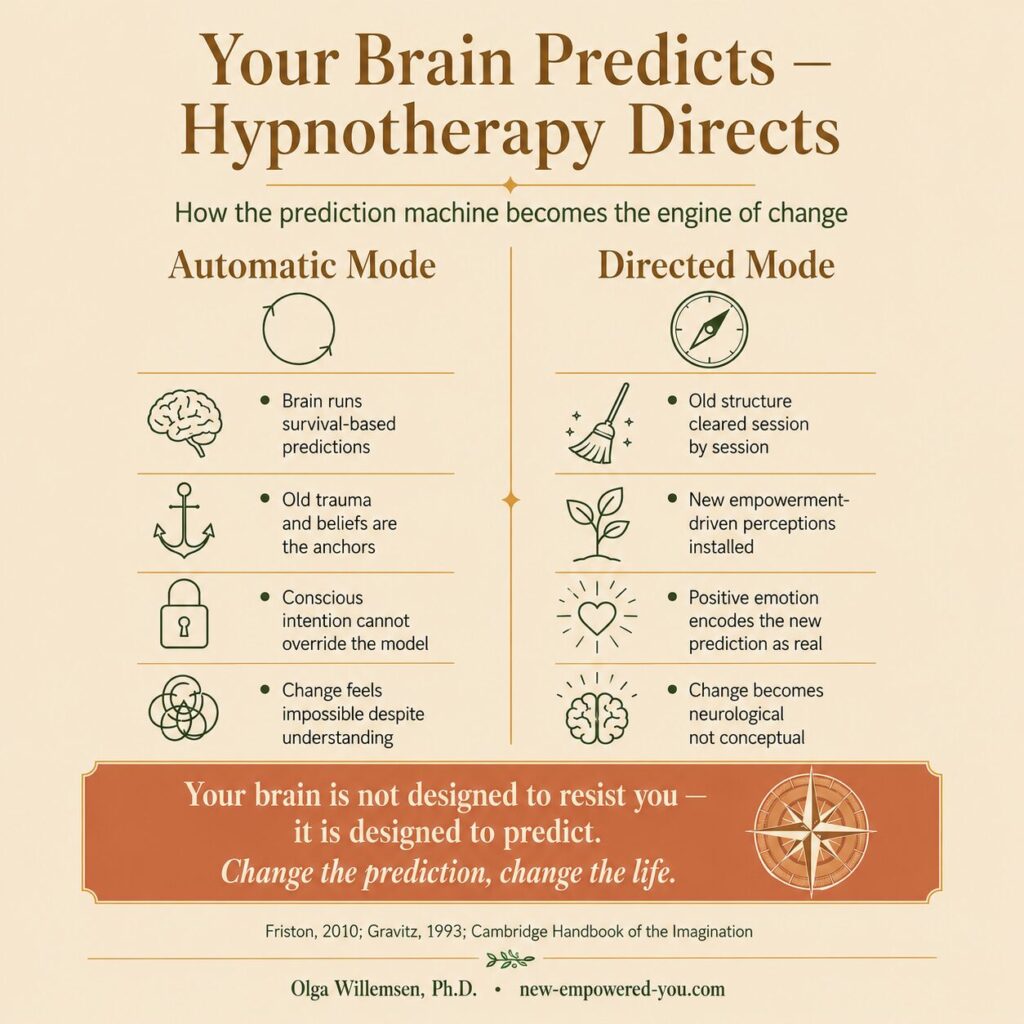
- Prediction is automatic imagery. The brain’s predictions are not abstract calculations: they are mental images of expected reality, generated continuously below the threshold of awareness. This is imagination operating at the involuntary, deep level.
- Voluntary imagination does not reach the level of prediction. Consciously visualizing a goal or rehearsing a positive outcome operates at the surface layer of the mind. The predictive model that drives automatic behavior cannot be overridden by deciding to imagine something different.
- Hypnotherapy works by installing new perceptions. The therapeutic goal is not to replace one conscious image with another. It is to shift what the brain treats as perceptual reality: the automatic predictions it uses to guide behavior.
- The old structure must be cleared before new perceptions can take hold. Unresolved experiences and limiting beliefs anchor the old predictive model. A new empowering perception cannot be installed in a structure that is still actively running an older, survival-based one.
- Positive emotion is the neurological signal for change. Strong positive feelings are not the same as positive thinking. McGaugh (2004) demonstrated that emotional arousal activates the systems that determine what the brain writes into long-term memory. A felt positive experience tells the brain a new prediction is worth encoding as real.
- A cumulative program rewrites the model; a single session does not. Most research on hypnotherapy uses isolated sessions. A carefully sequenced program where each session builds on the last targets the predictive model itself rather than producing transient suggestion effects.
What you have probably been told
For many people encountering hypnotherapy for the first time, something mystical still clings to the word. Stage performances, swinging pendulums, the sense that something unknowable is being done to a passive subject. This framing is not just inaccurate. It was already being dismantled two centuries ago.
Baron Étienne Félix d’Hénin de Cuvillers (1755 to 1841) was one of the rare scholars of his era who looked at the phenomena surrounding what was then called animal magnetism and reached a clear conclusion: there is no mysterious fluid. What is happening here is psychological. It is a science of the mind, and imagination is at the heart of it.
To make this systematic, he introduced no fewer than 312 words with the “hypno-” prefix, including hypnotique, hypnotiste, and hypnotism, more than twenty years before the Scottish surgeon James Braid is conventionally credited with coining these terms. As Gravitz (1993) documented in the American Journal of Clinical Hypnosis, Braid is usually but inaccurately given credit for originating this nomenclature. The Baron’s vocabulary was not academic excess. It was a declaration: this is a legitimate science of mental phenomena and imagination, and it deserves precise language.
He was right. The two centuries of research that followed have been explaining, in increasing detail, exactly how.
Imagination is genuinely central to how hypnotherapy works. Vivid mental imagery, visualization, and the evocation of feeling are real mechanisms, confirmed by a chapter in the Cambridge Handbook of the Imagination and a review from King’s College London. But understanding precisely how and why requires one further step, because the brain operates at two levels of imagination that are not the same.
One is voluntary. You consciously generate a picture: a goal, a desired future, a different version of yourself. You know you are generating it. You can stop whenever you choose.
The other is automatic. This is where the brain continuously creates predictions of what is about to happen, what is needed, and what is safe. These predictions are also imagery: mental models of expected reality, generated below the threshold of conscious awareness and used as the raw material of perception and behavior. You cannot override them by deciding to imagine something different.
The Baron was pointing toward this second level. Modern neuroscience has now mapped it.
The prediction machine: Karl Friston and the predictive brain
In 2010, neuroscientist Karl Friston published what has become one of the most cited papers in modern brain science: a unifying theory of brain function built around a single foundational premise. The brain’s primary job is not to perceive reality. It is to predict it.
Friston (2010), in his formulation of what is now called predictive processing (or the free energy principle), proposed that the brain continuously generates an internal model of the world and the body’s position within it. Rather than passively receiving sensory signals and computing a response, the brain runs forward predictions about what is about to happen, what the body needs to do, and how the social environment will behave. Incoming signals are then checked against those predictions. When the match is close enough, the brain treats the signal as expected and continues. When the mismatch is large enough to matter, the model updates.
This architecture is why habits, emotional patterns, and automatic behavior work the way they do. The predictions that run most smoothly, the ones that rarely generate large mismatches, become deeply embedded in the model. Over time, and especially under conditions of sustained stress or threat, the brain’s imperative is to conserve the models that have ensured survival. Changing the model costs metabolic resources and carries risk.
The brain is designed to predict reliably.
The implications are significant. When a person has an eating pattern, a body-image belief, or an emotional response that operates automatically regardless of their conscious decisions, this is not a character flaw. It is the predictive system doing precisely what it evolved to do.
The survival model built from earlier experience is running its predictions and filtering out signals that would contradict it. Conscious intention operates at a different level of processing. It does not have direct access to the prediction engine.
Imagination versus perception: why the distinction matters
This is where the science becomes precise in a way that the imagination framing misses. The Cambridge and KCL Reviews are right to note that voluntary imagination and hypnosis are distinct. That distinction points in an important direction.
Voluntary imagination, the kind you engage when you daydream or consciously visualize something, is a process generated from the top down. You produce it. You know you are producing it.
The brain does not necessarily update its predictive model based on something it recognizes as self-generated fiction.
Perception is different. Perception is what the brain treats as real. It is the live output of the predictive model: the brain’s current best estimate of what is actually happening. When the brain perceives something, the prediction is active and confirmed.
What changes behavior at a deep level is not what you imagine but what your brain predicts as perceptual reality. The goal in clinical hypnotherapy work is not to generate new images in the mind’s eye.
Hypnotherapy’s goal is to help the brain install new perceptions: perceptions of capability, safety, and genuine possibility, to replace predictions rooted in survival threat.
This is the precision the Baron was reaching for in 1820, and the Cambridge Review confirms it in a different vocabulary. The clinical question is not “can I make you imagine something?” It is: “Can we shift what your brain is predicting as real?”
Why clearing the old structure comes first
A new perception cannot be installed inside a predictive structure that is still actively running an older one.
Predictions rooted in survival have anchors.
Unresolved experiences that carried a genuine threat, whether emotional, relational, or physical, left a mark on the model.
Beliefs formed as conclusions from those experiences (“I am not enough,” “my body is the problem,” “I cannot trust this to last”) are not simply thoughts.
They are the brain’s committed predictions about what is likely to happen next.
They run automatically and bias what gets perceived.
The pattern I see most often involves people who report feeling as though something pulls them back just as they reach a point of real progress. Not laziness. Not self-sabotage in any moral sense. The old predictive model reasserts what it considers a safe and known reality.
When prediction is not aligned with the conscious goal, so the conscious goal eventually loses.
Work that bypasses this clearing phase and attempts to add new, positive imagery atop an unchanged predictive structure is asking the brain to renovate a room without first moving what is already in it.
This is the structural difference between a single-session suggestion protocol and a cumulative hypnotherapy program, in which each session builds on the last:
- Trauma is addressed.
- Limiting beliefs are examined and transformed.
- The old predictions are not overlaid but replaced.
Positive emotion: the signal that makes a new perception real
Once that structure has been cleared, something becomes possible that was not before. And at this stage, positive emotion is not merely a pleasant outcome of the work.
Positive emotion is the neurological signal that tells the brain the new perception is worth encoding as real.
The brain does not update its predictive model simply because a coherent new idea has been presented to it. What registers as significant enough to rewrite a deeply embedded prediction is emotional intensity.
This is consistent with what we know about emotional arousal and memory consolidation:
Strong feelings activate neuromodulatory systems that mark an experience as important enough to retain.
McGaugh (2004) demonstrated that the amygdala modulates the consolidation of emotionally arousing experiences, effectively determining which signals are worth writing into long-term memory. The same mechanism that makes a frightening experience almost impossible to forget can also work in the direction of empowerment.
When a client reaches the point where they can genuinely feel, not just think about but actually feel, the reality of a different future for themselves, that moment is not a visualization exercise. It is the brain receiving a prediction error strong enough to prompt it to update its model.
The felt sense of:
- empowerment
- being larger than the old pattern
- a genuine possibility opening
– is the signal the brain uses to decide that a new prediction is worth adopting.
This is why positive thinking, in the conventional sense, rarely produces lasting change. It operates at the conscious layer. It does not generate the emotional intensity that registers at the level of the predictive model.
What I work toward in the later stages of a program is this: the felt experience of the new perceptual reality. Not the image, but the body’s full response to it. That is the moment when change stops being conceptual and starts being neurological.
What this means for the reader
The same predictive mechanism that has maintained old patterns with such tenacity is also the mechanism through which real change becomes possible. This is not a design flaw. It is the architecture.
The brain is not your enemy in this. It is doing what it was built to do: protecting a model that once kept you safe.
What the research captures, particularly through single-session studies, is real. It also captures only a slice of what a carefully sequenced, cumulative program makes possible. Session by session, layer by layer, with trauma addressed, beliefs examined, and new perceptions given time to deepen, the predictive model itself shifts. That is the goal: not a pleasant session, but a different brain.
Understanding this requires no leap of faith. The framework belongs to Karl Friston. The observations span two centuries of practitioners, from a largely forgotten French Baron working in 1820 to the neuroscience of today.
A question worth sitting with
Think of one pattern in your life that you have tried to change through understanding it, and found that understanding alone was not enough. This was not a moral failure, but a predictive model running exactly as designed.
If you are curious about what it would mean to work at the level of the prediction itself, I would be glad to talk.
FAQ: How hypnotherapy works
Is predictive processing actually established neuroscience, or is it still a theory?
Friston’s predictive processing framework is one of the most-cited and influential theories in contemporary brain science, with strong support across multiple research streams, including neuroimaging, computational modeling, and behavioral studies.
Like any large unifying theory, it is debated at the edges and refined continuously.
The core proposition—that the brain generates forward predictions and updates them based on prediction errors—has substantial empirical support.
It is fair to describe it as a leading, evidence-supported framework rather than an accepted law of neuroscience. Friston (2010) is the foundational reference.
If my brain is designed to resist change, why does anyone change at all?
The predictive model is not static: it updates constantly based on prediction errors.
The question is not whether the brain can change, but what scale of signal is required to shift a deeply embedded prediction.
Significant life events, repeated new experiences, and targeted clinical work all generate prediction errors large enough to matter.
The brain changes readily in response to strong enough signals.
The challenge is generating signals that reach the level of the model rather than being filtered out as expected noise.
How is hypnotherapy different from visualizing positive outcomes on my own?
Voluntary visualization is a process generated consciously: the brain knows you are producing it.
Clinical hypnotherapy involves attentional narrowing, a specific quality of receptivity, and the graduated building of new perceptual experience across multiple sessions.
The Cambridge and KCL Reviews confirm that the neurocognitive mechanisms differ from those of voluntary imagination.
The distinguishing factor in a cumulative program is not any single session but the systematic clearing of the predictive structure that the new perception needs to occupy.
Does talking therapy not also work at the level of the predictive model?
It can and does. Cognitive behavioral therapy, for instance, generates prediction errors through structured behavioral experiments: the client acts in a new way, observes that the feared outcome does not occur, and the model updates.
Different approaches access the predictive model through different routes.
The distinguishing feature of a cumulative hypnotherapy program is the depth of the clearing work combined with the emotional intensity of the new perceptual installation — both of which affect how thoroughly the old prediction is replaced rather than coexisted with.
What is the evidence for hypnotherapy producing lasting behavioral change?
The evidence base varies by condition and study design. For pain management, irritable bowel syndrome, and certain anxiety-related concerns, there is moderate to strong evidence from clinical trials.
For complex behavioral change involving weight management and habitual patterns, the evidence is more limited, partly because most studies use single sessions or short protocols that do not reflect the architecture of a cumulative program.
The research confirms the mechanisms are real. The gap is in studying programs designed to address the predictive model systematically over time.
What role does trauma play in blocking new perceptions from taking hold?
Unresolved trauma maintains the predictive model in an ongoing state of threat orientation.
When the nervous system is organized around detecting and managing danger, the signal environment is not conducive to encoding an empowering new perception: threat prediction dominates and filters out competing signals.
Addressing the trauma changes the baseline condition of the model. It is not the only factor, but it is often the most structurally significant one.
New perceptions offered before this work has been done tend not to hold, not because the person is unwilling, but because the model has no room for them yet.
People Also Ask
How does hypnotherapy actually work?
Hypnotherapy works through a combination of focused attention, heightened receptivity to suggestion, and the deliberate use of imagery and emotion to shift how the brain processes experience. Modern neuroscience suggests the mechanism involves the brain’s predictive model: hypnotherapy helps generate the kinds of strong, emotionally resonant experiences that the brain treats as real enough to update its predictions. A cumulative clinical program goes further by first clearing the unresolved beliefs and experiences that anchor old behavioral patterns, then building new perceptual experiences in their place.
Does hypnotherapy change the brain?
There is growing evidence that hypnotherapy produces measurable changes in brain activity, particularly in areas related to attention, expectation, and emotional processing. Karl Friston’s predictive processing framework offers one explanation: sufficiently strong experiences, delivered with emotional intensity and attentional focus, can update the brain’s predictive model — the deep structure that drives automatic behavior. Whether this constitutes “brain change” in a lasting neurological sense depends on the depth of the program and the specificity of the work. Single sessions produce transient effects; a well-designed cumulative program targets structural change.
Is hypnotherapy evidence-based?
Hypnotherapy has an established evidence base for specific applications, including chronic pain, irritable bowel syndrome, and anxiety-related conditions. The evidence for complex behavioral change, such as weight management or habit transformation, is more limited by study design challenges rather than by a lack of effect. Most studies use short protocols that do not reflect what a carefully sequenced clinical program can achieve. The mechanisms are supported by neuroscience; the evidence base for outcomes is still catching up to the practice.
What happens in the brain during hypnosis?
Neuroimaging studies show that hypnosis involves shifts in activity in prefrontal regions associated with attention and executive control, as well as in areas linked to the sense of agency. The brain enters a state of focused, narrowed attention in which suggestion and imagery have a stronger influence on perception and expectation than in ordinary waking consciousness. From a predictive processing perspective, hypnosis may work in part by reducing the weight the brain gives to certain top-down predictions, making the system more receptive to updating its model, which is precisely what good clinical work uses to install new perceptions.
Can hypnotherapy rewire the brain?
“Rewire” is a loose term, but the underlying idea has neurological support. The brain changes structurally in response to experience: this is neuroplasticity. Strong, emotionally resonant experiences leave lasting traces in the predictive model. A cumulative hypnotherapy program designed to clear old belief structures and install new perceptual experiences is, in this sense, working with the brain’s natural capacity for experience-dependent change. The difference between a pleasant session and genuine rewiring lies in the depth of the clearing work and the emotional intensity of the new experience being built.
References
- Friston K (2010). “The free-energy principle: a unified brain theory?” Nature Reviews Neuroscience 11(2):127–138. https://doi.org/10.1038/nrn2787
- Gravitz MA (1993). “Etienne Félix d’Hénin de Cuvillers: a founder of hypnosis.” American Journal of Clinical Hypnosis 36(1):7–11. https://pubmed.ncbi.nlm.nih.gov/8368197/
- McGaugh JL (2004). “The amygdala modulates the consolidation of memories of emotionally arousing experiences.” Annual Review of Neuroscience 27:1–28. https://doi.org/10.1146/annurev.neuro.27.070203.144157
- Cambridge Handbook of the Imagination, chapter: Hypnosis and Imagination. Cambridge University Press. https://www.cambridge.org/core/books/abs/cambridge-handbook-of-the-imagination/hypnosis-and-imagination/6D147B67F49CEEF1BAA872BA28CE9325
- Oakley DA, Halligan PW. Hypnosis and Imagination. King’s College London. https://kclpure.kcl.ac.uk/portal/en/publications/hypnosis-and-imagination
About the Author

Olga Willemsen, Ph.D. > Certified Clinical Hypnotherapist & Transformational Coach
Olga Willemsen is the founder of New Empowered You, where she helps clients work through anxiety, burnout, and stubborn weight struggles using an evidence-based, pragmatic approach. She holds a Ph.D. in Natural Sciences and brings that same grounded mindset to her work in advanced hypnotherapy.
A certified member of the International Association of Counselors and Therapists (IACT), Olga trained in RTT, Neo-Ericksonian Hypnosis, and the Simpson Protocol. Her approach works with the mind’s patterns rather than against them, helping clients shift the habits and beliefs that keep them stuck.
Curious what’s really behind what’s holding you back? Let’s find out together.