

How to Cultivate Joy: Presence, Wonder, and What Children Already Know
Watch children arrive at school for the first time. They come in playful, curious, full of energy, joyful in the most natural way.
Somewhere along the way, something shifts. The evaluations begin. The conditions accumulate. Joy does not disappear overnight. It simply stops being practiced, and this becomes the norm for adulthood.
The brain is capable of joy — it is designed for it. But it also prioritizes survival, and nobody teaches us how to cultivate it.
Science increasingly recognizes joy as something distinct from happiness and documents the profound difference it makes in health, longevity, and how fully a life is lived. This post explores how to cultivate joy and what that means for the life you actually want.
Key Takeaways
- Joy is essential to living fully. Research links positive emotions to longer life, stronger immune response, and faster recovery from illness and surgery (Diener & Chan, 2011).
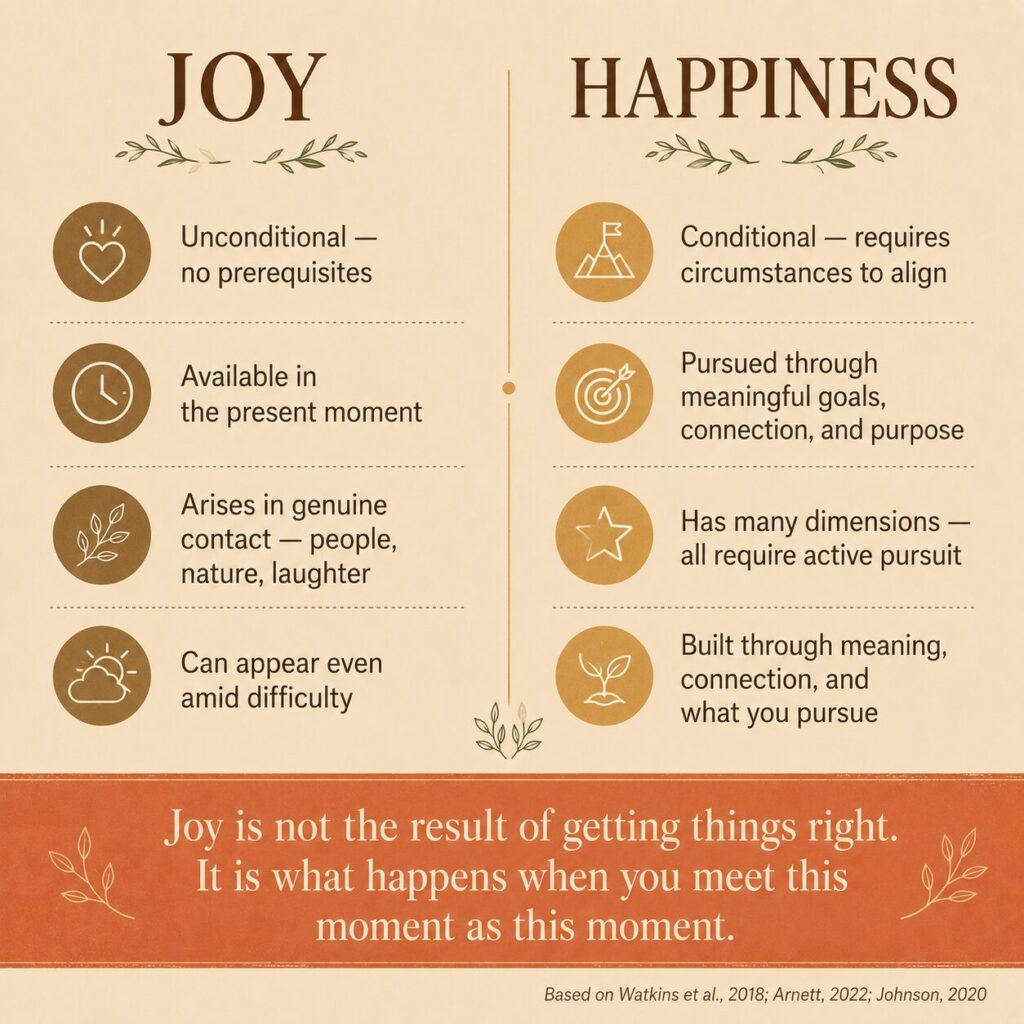
- Joy and happiness are distinct experiences. Joy is unconditional, arising through presence. Happiness is built through the active pursuit of meaningful goals, connection, and the overcoming of hardship. Both are essential to a fulfilling life.
- Joy has to be actively chosen. In a culture that systematically undervalues it, joy requires being valued, prioritized, and given space and time.
- The brain’s autopilot defaults to self-protection, predicting threats or suppressing emotions. This is the underlying mechanism in anxiety, depression, and burnout, and what crowds out joy.
- Joy arises through genuine contact with people you love, with nature, with something that makes you laugh.
- Specific gratitude is the most evidence-backed entry point. Noticing a particular moment, gesture, or texture opens the emotional spectrum toward joy more reliably than abstract appreciation.
- Integrative hypnotherapy works at the level of prediction structures, making presence less effortful and joy more naturally available.
Joy at the heart of a fulfilling life
The research on joy’s role in health and longevity compells to take it seriously.
People with higher levels of positive affect:
- live longer
- show stronger immune responses
- lower cortisol levels
- recover faster from illness and surgery (Diener & Chan, 2011).
Persistent anxiety and emotional suppression are associated with slower wound healing, increased inflammation, and more complications in recovery.
These findings point to something larger than health. Joy is a driving force of life. It is what gives life its depth, color, and forward pull. It is what makes everything else worth doing.
Joy is not the same thing as happiness
Researchers confirm this empirically: when people complete validated measures of positive emotions, joy and happiness emerge as two distinct experiences. (Watkins et al., 2018; Chauhan et al., 2019).
The distinction that matters most in practice is about conditions.
Happiness is conditional, and you need to actively pursue the conditions that foster it. I explore each across a six-part series: from what happiness is and the happiness of belonging and recognition, through innate relief from pain, motivation and persistence, and meaning and fulfillment.
Joy is unconditional. That does not mean it arrives without effort. In a culture that systematically undervalues it, joy has to be actively chosen: valued, prioritized, given space and time. The difference from happiness is in what that pursuit looks like. Happiness is built by meeting conditions. Joy arises from being present with what is already here: people you love, nature, something that makes you laugh.
Research describes it as spontaneous, arising in response to genuine contact with what is actually happening, rather than from achieving something (Chauhan et al., 2019). One integrative theory frames it as a “just right fit” between self and moment, a sense of alignment that has nothing to do with conditions being met (Arnett, 2022). Joy appears not only during happy or calm moments but also during illness, loss, or uncertainty (Roberts & Appiah, 2025).
Both joy and happiness are essential to a fulfilling life. Meaningful goals, connection, and overcoming hardship build happiness. Presence and genuine contact with what is here create the conditions for joy. Together, they are what it means to live fully.
What opens the door to joy
Certain qualities of inner awareness invite joy. Each works differently — and each, on its own, can be enough.
Presence is awareness of what is happening here and now. The mind is in the room — attentive to surroundings and to the moment, rather than somewhere inside itself resolving conflicts or planning what comes next.
Wonder is what it feels like to meet the world with an open mind and heart. Where presence keeps awareness in the moment, wonder allows that awareness to be genuinely surprised — to encounter something fresh rather than confirming what was already expected. The mind lights up.
Humor works the same way: a joke sets up a prediction and then gently disrupts it in a direction that is harmless and pleasurable. The same opening, the same lighting up.
When awareness is no longer dominated by thinking, something opens.
Gratitude directs awareness toward what already has value in your life. When you notice — really notice — what you appreciate, something in you responds. Research describes this as an upward spiral toward joy: specific appreciation for something real makes joy more likely (Watkins et al., 2018; Emmons & Afshar, 2021).
Each of these is its own invitation to joy.
Why adults stop noticing
Most adults have not consciously decided to stop experiencing wonder. What has happened is quieter and more structural.
The brain is, at its core, a prediction machine. Rather than processing raw incoming information afresh at every moment, it runs constantly updated models of what the world is likely to contain. When predictions are confirmed, processing becomes efficient and largely automatic. When predictions fail if something unexpected happens — the brain allocates attention, recalibrates, and learns.
This is an extraordinarily useful system. It is why you can drive a familiar route without consciously thinking about it, carry on a conversation while walking, or recognize a face in milliseconds. But efficiency comes at a cost to freshness. The more familiar something becomes, the less the brain needs to attend to it. It is already predicted. It is already filed.
It is the architecture of a well-functioning nervous system. But it means that repetition quietly extinguishes wonder — not because the things around you have become less remarkable, but because your brain no longer needs to look at them. You stop seeing your kitchen. You stop tasting your coffee.
Joy requires what prediction eliminates: genuine contact with what is actually here.
I write about the neuroscience behind this in more detail, including how hypnotherapy can work at the level of prediction structures rather than conscious thought, in my post on how hypnotherapy works.
For many people, the autopilot defaults to self-protection: predicting threats, suppressing difficult emotions, managing risk. This is the reason why anxiety, depression, burnout, and emotional eating are widespread. They are not separate problems but different expressions of the same survival autopilot.
As a result, quick pleasure is prioritized over genuine joy, favoring the small satisfactions of food or consumption over the deeper fulfillment that comes from presence and connection.
What children already know
Children are not wiser than adults. But their brains have had less time to build up prediction libraries; this is why their experience is actually different.
When a child meets a caterpillar, there is no pre-existing model for this specific caterpillar in this specific moment. The encounter is genuinely new. The sensory experience lands more fully.
This is what adults mean when they describe children as living “in the present moment.” It is less a spiritual state than a neurological one — the natural result of fewer accumulated predictions. The world is still being built. Things are still genuinely being encountered for the first time.
There is also less ego scaffolding around the experience. Children have not yet fully developed the self-monitoring layer that compares this moment to others, evaluates whether the current experience is worth the attention it receives, or filters experience through a sense of what one is supposed to feel. They make no social calculation about whether it is appropriate to be delighted. They are simply delighted.
The adult mind becomes preoccupied with automatic doing and self-protection rather than being. The capacity is still there. It simply has less room
How joy actually shows up
There is a measurable signal of genuine joy that researchers and clinicians pay attention to: the Duchenne smile.
Named after the 19th-century French neurologist Duchenne de Boulogne, a genuine smile of enjoyment involves two distinct muscle groups — the zygomatic major (which raises the corners of the mouth) and the orbicularis oculi (which creates the crinkle around the eyes). The eye muscle is largely involuntary. You can train yourself to produce a convincing mouth smile. You cannot easily fake the eye crinkle. When both engage together, the expression researchers call a felt or Duchenne smile appears. When only the mouth moves, researchers describe it as a social or non-enjoyment smile.
This matters as a practical tool for self-observation. When you genuinely smile not to signal pleasantness or ease social interaction, but because something has actually landed, your eyes engage. It is worth learning to notice the difference in yourself.
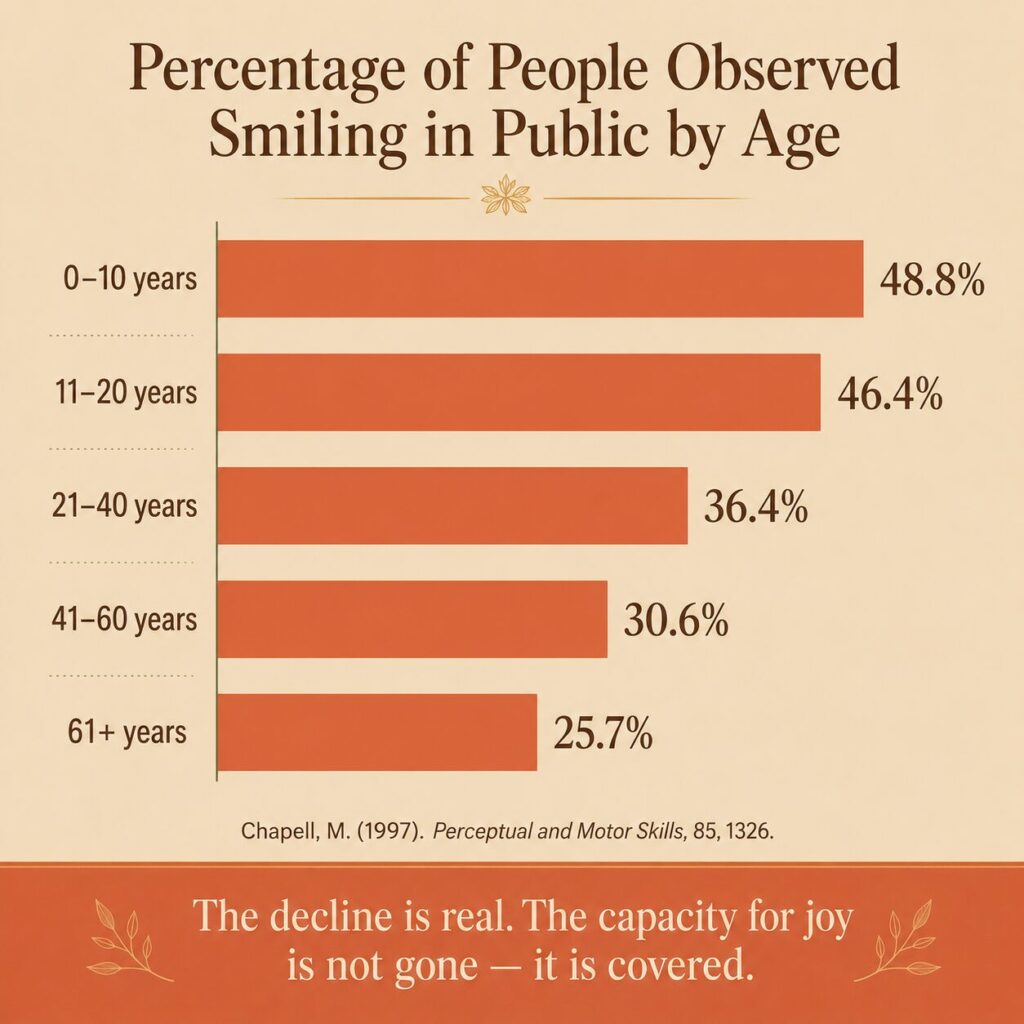
Research on smiling frequency across ages adds a useful dimension to this observation. In a large public observation study of 15,824 people, Chapell (1997) found that the percentage observed smiling at any given moment declined steadily across age groups:
A photographic analysis by Otta (1998) found a similar pattern, with particularly pronounced decline in middle-aged and older adults, especially men.
One note worth adding: a large observational video study found that while older adults smile less frequently, they tend to smile for longer durations when they do (McDuff & Glass, 2019). This may suggest that with age, joy becomes rarer but potentially more savored when it arrives.
A widely repeated claim that children smile “400 times a day” while adults manage only “20” has no traceable academic source. What the actual data show is a percentage-based decline meaning that in any given public moment, roughly half of young children are visibly smiling, while that proportion drops to about one in four by older adulthood.
As with all statistics, these describe a general trend, not any particular person. Within any age group, the range is wide: some people more often than others, some more genuinely, others more politely.
Joy is universal
Joy is universal in its essential character — shared, fulfilling, and experienced in the present moment. What varies across cultures is the source and context: when people feel it, how they express it and what in their identity and history gives them access to it (Golovanivskaya & Efimenko, 2022, Tan & Titova, 2024). The invitation to joy looks different depending on where you grew up. Foundationaly, it is the same.
What stands out from the cross-cultural literature is that joy is consistently most available in conditions of genuine, unguarded contact: with another person, with nature, with something unexpected, with a moment of humor or beauty.
How to cultivate joy: a practical invitation
The research makes one thing clear: joy can be cultivated. This does not mean joy can be produced on command. It means that conditions can be created in which joy is more likely to arise, and that some of those conditions are learnable (Casioppo, 2020; Roberts & Appiah, 2025).
The most evidence-supported entry point is gratitude with specificity. Vague gratitude (“I’m grateful for my health”) tends to remain conceptual. Specific gratitude: noticing a particular moment, a texture, a sound, a gesture — activates the same attentional capacity that joy requires. Research describes this as an upward spiral: specific appreciation opens the emotional spectrum toward joy (Watkins et al., 2018; Emmons & Afshar, 2021).
Contemplative practice of virtually any kind: mindfulness, meditation, breath-focused awareness — appears to support joy by training the capacity to be in the present moment without immediately categorizing and filing it (Casioppo, 2020). The mechanism connects directly to the predictive brain: presence interrupts the automatic loop and creates the conditions for genuine encounter.
Social connection and belonging are also consistently linked to joy across cultures and populations. Joy tends to arise primarily in contact. You don’t need to be an extravert to create an unguarded, present-moment connection with another person, even briefly, and fertile conditions for joy (Roberts & Appiah, 2025).
Practically, this might look like:
- One unnarrated observation per day: choose something: an object, a sound, a shaft of light — and look at it for thirty seconds without describing or explaining it. Just look.
- Specific gratitude, written or spoken: complete the sentence “I’m specifically grateful for the moment today when…” rather than naming an abstract category.
- Transition pauses: before moving from one activity to the next, take 60 seconds to simply be rather than immediately starting the next task.
- Notice your eyes: when you smile, notice whether your eyes engage. The difference between a felt and a social smile is something you can learn to recognize in yourself.
For many people I work with, the difficulty is not knowing what to do. The difficulty is that the gap between knowing and doing is wider than it appears — because the obstacle is not at the level of thought.
This is where integrative hypnotherapy works differently from purely cognitive approaches. Rather than revising what you think, it works at the level of what you automatically expect: the prediction structures that govern your nervous system’s readiness to engage with experience. When those structures shift, presence becomes less of an effort and more of a natural state. Joy stops being something you have to remember to look for.
The recording “Reclaim Your Joy: Hypnosis for Ease & Presence” was designed specifically for this purpose, as a way of training the nervous system toward the openness in which joy can land. Where the practices create conditions at the surface, this recording works at depth. If you are curious to explore this, the recording is available here:
Presence as the marker of an aligned life
Joy arises regardless of circumstances. Research shows it can appear even during illness, loss, or uncertainty, when something genuine briefly pierces through (Roberts & Appiah, 2025). It requires genuine contact with what is actually here.
The brain that runs most of adult life is extraordinarily good at what it does: keeping you safe, managing risk, navigating the familiar with minimal effort. It is also designed for joy. But when survival and self-protection are unconsciously prioritized above everything else, joy quietly falls to the bottom. The capacity is still there. Reclaiming it is a choice: to value it, to make space for it, to meet this moment as it actually is.
A small invitation: think of the last time you felt a flash of genuine joy. Where were you? What made it possible? Notice what was different about that moment. Chances are, it was a moment when the past stepped back, and the future briefly stopped mattering.
If you are curious about working with this more intentionally, through your own nervous system rather than through effort alone, I am here.
FAQ: How to cultivate joy
What is the difference between joy and happiness?
Happiness is conditional, built through the active pursuit of meaningful goals, connection, recognition, and overcoming hardship. Joy is unconditional: it arises in genuine contact with what is actually present: people, nature, laughter, a moment of beauty — independent of whether life looks the way we want it to. Research confirms they are psychologically distinct constructs with separate factor loadings in validated measures (Watkins et al., 2018). Both need to be cultivated. A full life makes room for each.
Can joy be cultivated, or is it always accidental?
Research supports intentional cultivation, though not direct production. The most evidence-backed approaches work by creating conditions in which joy is more likely to appear: specific gratitude, contemplative practice, genuine social connection, and the interruption of automatic prediction (Casioppo, 2020; Roberts & Appiah, 2025). Joy resists being manufactured on demand. It responds to an environment of presence and openness.
Why do children seem to experience joy more readily than adults?
Children have less automatic prediction patterns, which means more of their experience is genuinely new. They also have less ego-monitoring: fewer social scripts about how they are supposed to feel or what is worth being delighted by. The result is more direct sensory and relational contact, which is the condition joy favors. Adults can recover this capacity by practice.
What does smiling frequency actually show across age?
A public observation study of 15,824 people found the proportion observed smiling declined steadily from 48.8% in children aged 0–10 to 25.7% in adults aged 61 and over (Chapell, 1997). A photographic study found similar patterns (Otta, 1998). The widely shared statistic that children smile 400 times per day has no academic source. The real data shows a percentage-based decline in how often people are observed smiling, not a specific count. As with all statistics, these describe a general trend, not any particular person. Within any age group, the range is wide: some people at 60 smile more freely than most at 20, some more genuinely, some more politely.
How is hypnotherapy relevant to joy and presence?
Most approaches to cultivating joy work at the level of behavior or conscious thought. Integrative hypnotherapy works at the level of the brain’s automatic expectations, the prediction structures that govern whether you are habitually open or habitually guarded toward experience. When these patterns shift, presence requires less effort, and joy becomes more accessible as a result. You can read more about the underlying mechanism here.
Is joy experienced the same way across cultures?
The core features of joy: its intensity, social quality, event-driven nature — appear to be universal. But how joy is expressed and what cultural conditions support it vary (Golovanivskaya & Efimenko, 2022; Tan & Titova, 2024). Cross-cultural research also suggests that the relationship between self and joyful experience differs depending on whether the cultural frame is more individualist or collectivist, affecting whether joy feels most alive in personal achievement or in shared connection.
About the Author

Olga Willemsen, Ph.D. > Certified Clinical Hypnotherapist & Transformational Coach
Olga Willemsen is the founder of New Empowered You, where she helps clients work through anxiety, burnout, and stubborn weight struggles using an evidence-based, pragmatic approach. She holds a Ph.D. in Natural Sciences and brings that same grounded mindset to her work in advanced hypnotherapy.
A certified member of the International Association of Counselors and Therapists (IACT), Olga trained in RTT, Neo-Ericksonian Hypnosis, and the Simpson Protocol. Her approach works with the mind’s patterns rather than against them, helping clients shift the habits and beliefs that keep them stuck.
Curious what’s really behind what’s holding you back? Let’s find out together.


