

The Missing Piece: Addressing the Psychology of Sustainable Weight Loss
Introduction
We have explored the myths of “calories in vs. calories out” and the importance of hormonal balance, but weight management involves more than just calories and metabolism.
Your thoughts, emotions, and long-held beliefs are the “software” that runs your metabolic “hardware”. Chronic stress elevates cortisol, a hormone that promotes insulin resistance and abdominal fat storage, while limiting beliefs like “I will never stick to a diet” can trigger self-sabotage.
In the final part of our series, we look at the psychological dimension: how tools like hypnotherapy can calm the stress response and make healthy behaviors feel effortless rather than like a constant struggle.
Table of Contents
Key Takeaways: Psychology of Sustainable Weight Loss
- The Mind-Body Command Center: Your thoughts and emotions are the “software” that runs your metabolic “hardware.” If your brain perceives a state of threat or chronic stress, it will prioritize fat storage over fat burning, regardless of your diet.
- The Cortisol Factor: Chronic stress and lack of sleep elevate cortisol levels, which increase insulin resistance and boost ghrelin (the hunger hormone). This biological chain reaction makes you crave high-carb “comfort foods” as a survival mechanism.
- Beyond Willpower: Weight management is rarely about a lack of discipline; it’s about subconscious patterns. Tools like hypnotherapy help address emotional eating and limiting beliefs by calming the stress response at the root.
- The “Small Win” Paradox: Losing just 5–10% of your body weight provides massive biological benefits, improving blood sugar, reducing joint pressure, and easing sleep apnea, even if it doesn’t match a “perfect” aesthetic ideal.
- Sustainable over Rapid: The goal is to move from a “restriction mindset” to a “nourishment mindset.” Lasting success happens when healthy behaviors become a natural part of your identity rather than a daily battle.
Mindset, hormones, and habits: integrating the psychological dimension
Beyond myths: At this point, it’s clear that weight management involves more than chemistry and physiology. Our thoughts, emotions, and long‑held beliefs powerfully influence our eating habits, activity levels, and resilience. Chronic stress elevates cortisol, promotes fat storage, and undermines willpower. Conversely, positive beliefs and a sense of self‑worth can make healthy behaviours feel natural.
The separate post on losing weight with hypnotherapy delves into this psychological terrain. It highlights how limiting beliefs such as “everybody in my family is overweight, so I must be too” or “I will never stick to a diet” can sabotage efforts.
Mindset research by psychologist Alia Crum shows that participants who believed they had eaten a high‑calorie food stayed satiated longer and lost weight more easily than those with negative beliefs.
Hypnotherapy disarms negative beliefs, raises self‑esteem, and makes healthy behaviours effortless. Case studies describe clients who overcame emotional eating after addressing childhood trauma or feelings of unworthiness and subsequently experienced sustainable weight loss.
Practical takeaway: Pay attention to your mental landscape.
- Techniques such as mindfulness, hypnotherapy, or cognitive behavioural therapy can help identify and change sabotaging beliefs.
- Addressing emotional triggers for overeating, boredom, stress, and loneliness often leads to lasting changes in eating behaviour.
When combined with an understanding of energy balance, nutrient quality, and movement, psychological work can transform weight management from a constant struggle into an integrated lifestyle.
Learn about my approach to sustainable weight loss using hypnotherapy here.
Putting it all together: practical strategies for sustainable weight management
Understanding these myths underscores a broader truth: weight management is not solely about counting calories.
Energy balance is necessary but not sufficient.
The human body adapts to energy deficits and surpluses, and individual responses vary. Below are practical guidelines that integrate the science discussed above with behavioural insights:
- Choose nutrient‑dense foods. Fill your plate with lean proteins, colourful vegetables, whole grains, and healthy fats. These foods support satiety, reduce cravings, and supply the building blocks your body needs.
- Sequence your meals wisely. Start with protein and fiber, then add complex carbohydrates. This slows glucose absorption and helps control appetite (news.weill.cornell.edu).
- Avoid extreme restriction. Severe dieting can trigger cortisol spikes and metabolic slowdowns (Tomiyama, 2010). A moderate deficit combined with periodic maintenance phases or intermittent fasting may yield better long‑term results.
- Move your body, but don’t rely solely on exercise. Stay active throughout the day by walking, taking the stairs, or doing household chores. Structured exercise improves health but may not burn as many extra calories as you think.
- Manage stress and sleep. Chronic stress and sleep deprivation elevate cortisol and ghrelin, hormones that increase appetite and promote fat storage (Taheri, 2004). Incorporate relaxation techniques, adequate sleep, and restorative activities.
- Address the mind–body connection. Explore tools like hypnotherapy or coaching to identify limiting beliefs and emotional triggers. Developing a positive mindset supports long‑term behaviour change.
- Stay flexible and curious. Avoid rigid rules (e.g., “never eat carbs after 7 pm”). Monitor how your body responds and adjust. What works for one person may not work for another.
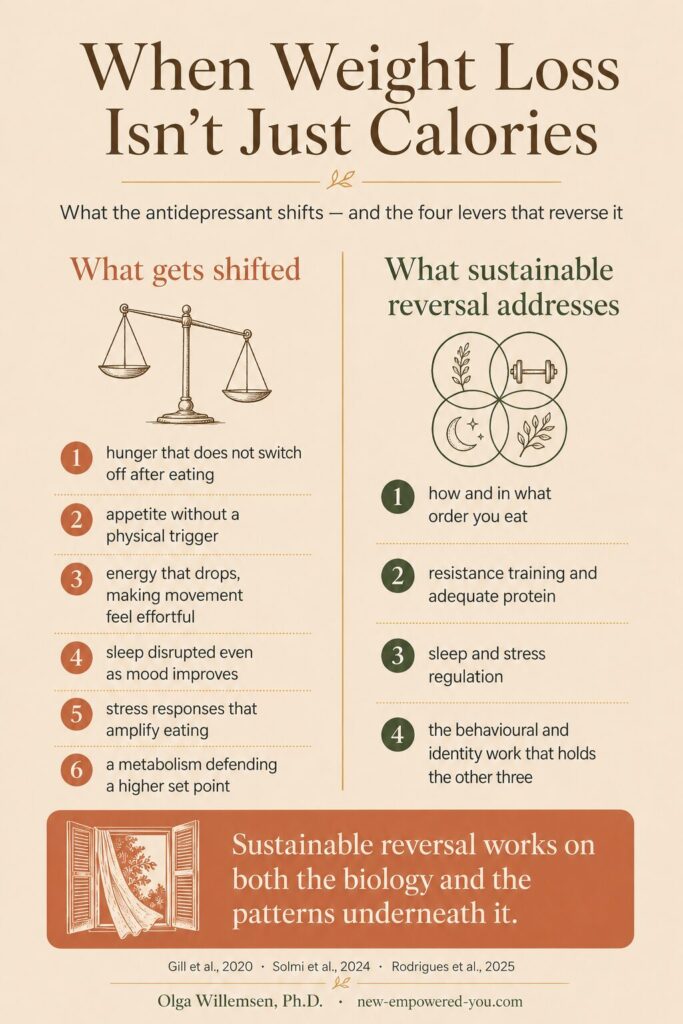
Conclusion: A nuanced view of calories and weight loss
By integrating an understanding of energy balance, nutrient quality, and psychological resilience, you transform weight management from a battle of willpower into an integrated lifestyle.
Instead of clinging to myths, adopt a holistic approach that combines:
- nutrient quality
- mindful eating
- flexible protocols
- sustainable activity
- mental wellbeing
Working with your body rather than against it makes lasting change not only possible but enjoyable.
FAQ: Psychology of Weight Loss
How does stress actually make me gain weight?
When you are chronically stressed, your body produces high levels of cortisol. This hormone signals your body to store fat, particularly abdominal fat, and increases your cravings for “quick energy” foods (sugar and refined carbs) as a survival mechanism.
Why do I have no willpower when I’m tired?
Sleep deprivation reduces leptin (the hormone that tells you you’re full) and increases ghrelin (the hormone that makes you hungry). This isn’t a character flaw; it’s a biological “hunger alarm” that makes willpower nearly impossible to maintain.
Can hypnotherapy really help with weight loss?
Yes. Hypnotherapy doesn’t “make” you lose weight directly; instead, it addresses the subconscious patterns, limiting beliefs, and emotional triggers that lead to self-sabotage. It helps calm the stress response, making it easier to stick to the healthy habits discussed in Parts 1 and 2.
Is losing 5% of my body weight really enough?
Absolutely. From a medical perspective, a 5–10% weight loss is a “major win.” It can significantly improve ovulation in PCOS, lower blood pressure, reduce joint pain, and improve insulin sensitivity. Success is measured by health markers, not just the number on the scale.
About the Author

Olga Willemsen, Ph.D. > Certified Clinical Hypnotherapist & Transformational Coach
Olga Willemsen is the founder of New Empowered You, where she helps clients work through anxiety, burnout, and stubborn weight struggles using an evidence-based, pragmatic approach. She holds a Ph.D. in Natural Sciences and brings that same grounded mindset to her work in advanced hypnotherapy.
A certified member of the International Association of Counselors and Therapists (IACT), Olga trained in RTT, Neo-Ericksonian Hypnosis, and the Simpson Protocol. Her approach works with the mind’s patterns rather than against them, helping clients shift the habits and beliefs that keep them stuck.
Curious what’s really behind what’s holding you back? Let’s find out together.


