
Is Free Will an Illusion? What Automatic Behavior Reveals About Choice
Is free will an illusion? It’s a fair question to ask once you look closely at how much of your own thinking, feeling, and behavior happens without you ever deciding it.
Go for a run and your physiology changes. Spend an afternoon in the sun, and it shifts a little more. Both are worth doing, and both belong in any ordinary idea of taking care of yourself. But if what you’re actually carrying is real unhappiness, a pattern that’s been running for years, neither one touches it.
What does touch is something far smaller and far faster: a few deliberate breaths: slower, deeper, rhythmic instead of shallow. That single adjustment reaches your physiology immediately, and because emotion is expressed through physiology, it reaches your emotional state just as fast. It hands you something that a run or an afternoon outside can’t: an immediate sense that you are not simply being carried along by whatever your body and mind are already doing.
That small example holds the real question underneath this piece. How much of your life are you actually choosing, and how much is simply happening to you, running on a track laid down somewhere in your past? Looked at one way, almost everything about you right now, including the thought you’re having as you read this sentence, was generated by a brain running on patterns it built decades ago, which can make a life feel like it belongs to someone else’s design. Looked at another way, every one of those patterns was built the same way, through repetition, through what got reinforced, through what worked once and then kept running. Which means the same mechanism that can make a life feel predetermined is also, once you get hold of it, what makes you the one who keeps writing it.
That’s what this piece actually traces: where all that automatic activity comes from, how it shows up in your life, what the famous experiments on free will really showed, and what genuinely interrupts a pattern once it’s no longer serving you.
Key Takeaways
- The 95 percent figure is a myth. The widely repeated claim that 95 percent of thought, feeling, and behavior is unconscious was never measured. It traces to a hypothetical in a 1998 paper on willpower (Baumeister et al.), a rhetorical example in a 1999 review (Bargh & Chartrand), and a 2002 Harvard Business Review estimate about consumer decisions, not an actual experiment that counted conscious versus unconscious activity.
- Automaticity runs in four layers. The body regulates itself through functions such as heart rate, hunger, and thirst; instinct produces evolved reflexes and reproductive drives; skill is built through repetition (walking, reading, speaking); and personality forms from personal, societal, and generational experiences.
- A brain signal precedes conscious intent. Benjamin Libet’s 1983 experiment found a measurable brain signal, the readiness potential, appearing several hundred milliseconds before people reported feeling the urge to act, a finding later popularized, inaccurately, as proof that free will is an illusion.
- Libet proposed a veto, not an illusion. He argued that consciousness retains a window to block or redirect an action already underway, meaning the start of an impulse can be automatic while the choice to follow through, or not, remains intact.
- A 2012 study challenges the premise. Schurger, Sitt, and Dehaene proposed that the readiness potential may reflect ordinary background neural noise crossing a threshold rather than evidence that a decision had already been made, which would considerably soften the original interpretation.
- Identity is built from the same patterns. Because thinking, feeling, and acting run automatically most of the time, identity is made of that same habitual material, and it can change when the underlying pattern changes.
- Several automatic loops usually run together. Most people are running several negative loops at once, based on low self-worth, inability to regulate their own feelings and emotions, and impacting different areas of their lives, like their wellbeing, relationships, and career.
- Breathing changes physiology the fastest. Because emotional state is expressed through physiology, a deliberate shift in breathing can reach the body immediately, while hypnosis reaches further than any of the tools discussed, because it works directly with the layer where a pattern was originally formed.
The number everyone quotes, and why it keeps getting repeated
You’ve probably come across the claim that around 95 percent of what we think, feel, and do happens without conscious involvement. It shows up in books, in Instagram posts, in therapy training materials. I’ve used it myself, more than once, without stopping to check where it came from.
It turns out the number was never measured. It traces back to a hypothetical example in a 1998 paper on willpower (“even if it were shown that 95% of behavior consisted of… automatic processes,” Baumeister et al., 1998), a psychologist’s rhetorical illustration of automaticity a year later (Bargh & Chartrand, 1999), and a Harvard Business Review estimate about consumer decision making, published by marketing professor Gerald Zaltman in 2002. None of these is the outcome of an experiment that separated conscious from unconscious mental activity and counted. Nobody has run that experiment. It isn’t obvious how you would.
What’s interesting is that the number got picked up anyway and stuck because it matches what’s actually observable in how people behave, for example, how they buy things. A purchase rarely follows a rational weighing of options. It follows a triggered emotion, and someone who understands that can overrule the logic, pass the guards, and trigger that emotion on purpose. That’s uncomfortable to sit with: we are, all of us, to an extent manipulable through the automatic layer of the mind.
So, the unproven 95% don’t make the underlying claim wrong. Set the figure aside and look at where all this automatic activity actually originates, and the case holds up on its own.
Where repeating patterns actually come from
Automaticity is built in layers, and these explain different parts of what you experience as “just how I am.”
THE BODY. Heart rate, breathing, digestion, body temperature: all running without a shred of conscious involvement, managed entirely below the level of thought. The body also produces impulses rather than thoughts: hunger, thirst. None of this is something you reasoned your way into. It’s older than reasoning.
INSTINCT. Survival instinct (the reflex that pulls your hand off something hot before you’ve registered pain, the fear of heights or spiders that forms faster and resists unlearning more than an arbitrary fear would, the discomfort of public speaking or of being excluded from a group, which research links to the same circuitry that processes physical pain) and reproductive instinct (the pull of sexual attraction) sit alongside each other here, both evolved, both older than any individual’s own experience.
SKILL. Walking, running, using cutlery, riding a bicycle, reading, speaking, driving a car. Every one of these took real, effortful repetition to learn, and every one of them now runs without a trace of that effort. You don’t think about walking until you stumble. You don’t think about recognizing letters on a page until you see a text in a foreign language, particularly in a different script.
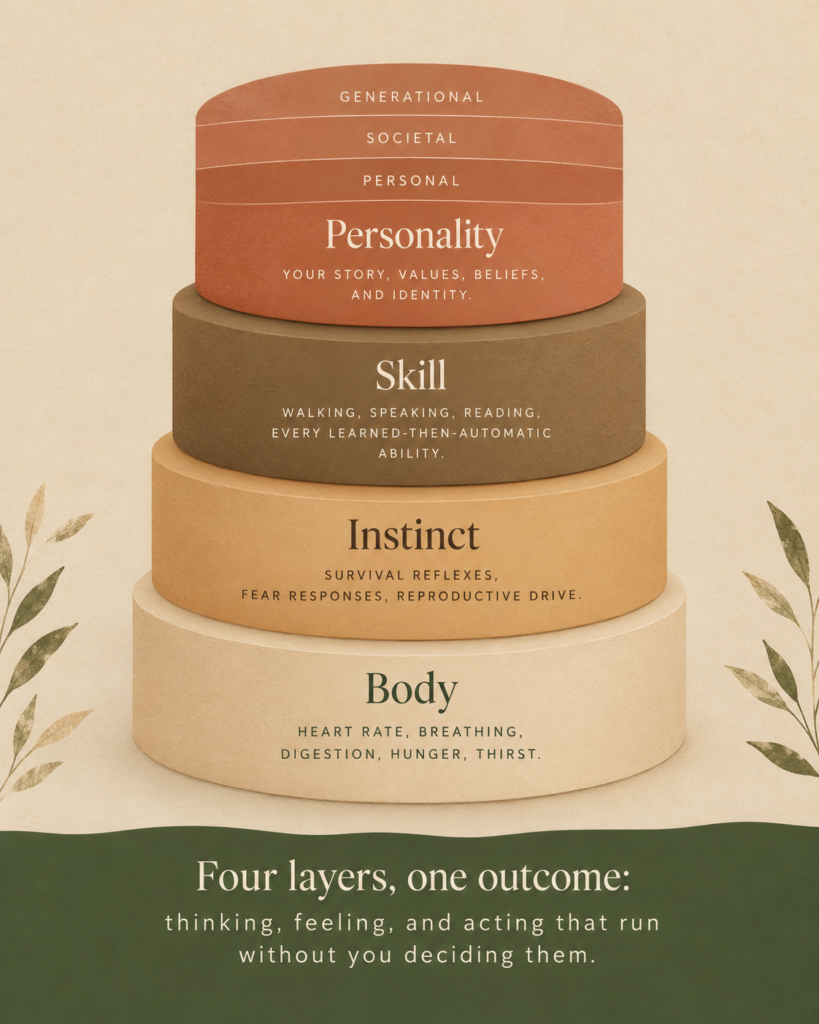
PERSONALITY. This is the layer with the most moving parts, so it splits into three.
The personal level is what is built in the small group you grew up in (caregivers, siblings), the first evidence you gathered about what it takes to be accepted, loved, and cared for (Bowlby, 1969).
The societal level is the larger group you were shaped by without choosing it: nationality, gender, generation, religion, or a secular belief system that functions the same way, the educational system you went through, the assumptions nobody in the room thought to question.
The generational level sits underneath both: a growing body of research suggests that impactful experiences can leave a mark that’s passed forward through epigenetic mechanisms.
Within the personal level, both positive and negative experiences form us.
- Conflict between parents
- a parent’s illness or addiction
- a death in the family
- long stretches of feeling unseen
– What researchers call adverse childhood experiences (Felitti et al., 1998) are more common than most people assume. I’ve laid out the specific figures in my mental statistics article rather than repeating them here.
But just as much of what gets absorbed at this level is good, for example, safety, warmth, openness, curiosity.
Both kinds of experience get encoded the same way, through repetition, into patterns that then run automatically. That’s worth holding onto, because it means automatic isn’t a synonym for damaged. Most of what runs automatically is essential, helpful, and runs well.
How these repeating patterns show up
All four layers express themselves through the same three channels.
Thinking. The same beliefs, the same expectations, opinions that feel like conclusions but are really just patterns repeating themselves without being re-examined.
Feeling. A default emotional response to a given kind of moment. One person meets a setback with sadness, another with anger, a third simply shuts down and stops feeling much of anything. None of these is chosen in the moment. They’re the groove the nervous system already runs in.
Acting. What actually gets done: how you interact with others, how you treat yourself, what happens, almost on its own, in a familiar kind of situation.
Identity is built from the same repeating patterns
If thinking, feeling, and acting all run automatically most of the time, then identity isn’t exempt from that. It’s made of exactly this material: the habitual thought, the habitual feeling, the habitual reaction, repeated daily until they add up to something that feels like “who I am.”
The brain’s job, according to the dominant model in contemporary neuroscience, is less like recording what’s actually happening and more like predicting it based on everything learned so far (Friston, 2010; I’ve written about this mechanism in more depth in How Hypnotherapy Works). You react to your own prediction of the world, not the world itself, and the reaction reinforces the same prediction again tomorrow. Identity gets recreated this way, daily, out of habit rather than fixed fact.
Which means identity isn’t fixed. When the underlying pattern changes, identity changes with it, sometimes completely. Someone who has lived years of fear can become someone relaxed and capable. Someone who has carried, since childhood, a quiet certainty that they weren’t wanted can become someone trusting, feeling loved, and free of the past. That is the same mechanism that built the old identity, now building a different one.
Is free will an illusion? What a famous experiment actually showed
In the early 1980s, a researcher named Benjamin Libet ran a deceptively simple study. He asked volunteers to make a small, spontaneous movement, a flick of the wrist, whenever they felt like it, with no cue or plan. While they did this, he recorded their brain activity, and he had them watch a fast-moving clock and note the exact instant they first felt the urge to move.
Two things showed up. First, what you’d expect: people felt the urge, then they moved. But tucked in before that, Libet’s recordings showed a third event, a slow buildup of brain activity, now called the readiness potential, that began several hundred milliseconds before people reported feeling the urge at all (Libet, 1983). The brain appeared to be preparing the action before the person consciously decided to do it.
That detail is what made the study famous, and it’s also where it gets routinely flattened into “science proves free will is an illusion.” Libet himself didn’t draw that conclusion. What he actually argued was narrower and more useful: the impulse to act starts outside awareness, but awareness still has a window to step in before the action happens, to let it through, slow it down, or stop it. A kind of veto. You might not be the one to strike the very first spark, but you get a say in what happens next.
There’s also a genuine scientific debate about what that early signal even is. More recent work (Schurger, Sitt, & Dehaene, 2012) suggests that the readiness potential may just be ordinary background noise in the brain, crossing a threshold at a more or less random moment, rather than evidence that a decision had already been quietly made.
Either way, here’s what matters for everything else in this piece: the starting impulse, for a movement, a thought, an old emotional reaction, does seem to be generated automatically, below the level where you experience choosing. That fits everything the sections above describe. But an automatic start is not the same thing as no choice anywhere in the process.
Free will, in any form worth having, was never going to mean outrunning your own nervous system. It means noticing a pattern once it’s already underway and deciding deliberately whether to let it run or interrupt it. That noticing is what takes real effort, because it works against momentum that’s already there, and it’s the entire premise of the work I do with clients.
A repeating pattern isn’t the problem until it sets a boundary you didn’t choose
None of this makes automatic a synonym for broken. If it were, nobody could function: imagine having to consciously monitor your own heartbeat or redecide how to hold a fork at every meal. Most automaticity is simply efficiency, freeing your attention for whatever the moment actually needs.
But every so often, a pattern that was built to solve an old problem keeps running in a life that no longer has that problem, and it becomes a boundary nobody agreed to.
“I felt stuck in my business, with my levels of confidence, as if I was blocked and unsure why.” — E.H.
Most people are running several negative loops at once, based on low self-worth, inability to regulate their own feelings and emotions, and impacting different areas of their lives, like their wellbeing, relationships, and career. These loops don’t respond to willpower or information because willpower and information aren’t the level any of them run on.
What actually interrupts a repeating pattern
If the problem lives below the level of conscious reasoning, the fix has to reach that level too. A few things genuinely do.
BREATHING. Of all the things running automatically in the body, breathing is the one function you can consciously and deliberately influence. A slower, fuller breath, or simply a steady rhythm instead of something shallow, reaches your physiology immediately, and because emotional state is expressed through physiology, it reaches your emotional state at the same speed. It won’t resolve a pattern on its own, but it hands you something most interventions can’t: an immediate, felt sense that you have some say over what’s happening in you right now. I’ve written a full piece on this specifically; see Breathing for Wellbeing.
JOURNALING. Writing things down can surface a thought or belief you hadn’t noticed was running on repeat. It’s worth doing. Yet, insight on the page doesn’t reliably translate into a different pattern in the body.
MEDITATION. In principle, meditation interrupts the pattern by creating space around it. In practice, for most people who aren’t monastics with decades of training, it mostly means sitting with thoughts that keep arriving and fighting them, which is its own kind of effortful and not always the calm experience it’s sold as. Still worth attempting, honestly.
GRATITUDE PRACTICE. More effective than it sounds, and for a specific reason: it isn’t the writing that matters; it’s that you’re deliberately generating a positive emotional state, which shows up in physiology the same way any other emotional state does. That’s a different mechanism from simply listing things you’re glad about. I’ve written about how to do this properly in The Best Gratitude Practice.
HYPNOSIS. This reaches furthest because it works directly with the layer where a pattern was originally written, rather than arguing with its downstream effects. The nervous system is capable of remarkably quick change once that root layer is actually accessed, which is the mechanism behind the results people describe (see How Hypnotherapy Works for the full explanation). This is usually what clients describe, first the understanding, then the relief that follows it:
“She helped me to understand why I have this problem.” — L.C.
“A steadily increasing sense of lightness, as in weight lifted from my shoulders.” — A.
Why repeating patterns aren’t permanent
On an ordinary day, if nothing interrupts it, almost everything runs on the patterns built early: the body’s own processes, instinct, skill, personality, all of it managed by a nervous system doing an enormous, continuous job without asking permission. Count everything that’s actually happening in you right now, every heartbeat regulated, every signal processed, every prediction quietly confirmed, and the honest answer isn’t that 95 percent of you is automatic. It’s closer to nearly all of it. The conscious, deliberate part is a small, hard-won sliver.
That can sound bleak. Set it next to the free will question from earlier, and it’s easy to land on “my life is simply happening to me, on a track somebody else laid down.” But the same evidence points the other way, too. Once you can see that it’s you and not fate, generating the thinking, the feeling, and the reacting, the same recognition that makes a pattern explicable also makes you the one who gets to keep writing it. Not through understanding it better. Through choosing, on purpose, with the kind of effort that goes against the current rather than with it.
If you’d like support figuring out which patterns are actually running the show and how to interrupt them at the level they operate on, that’s the work I do with clients. You’re welcome to book an introductory session whenever it feels right.
FAQ
Is free will an illusion?
Not in the way the famous experiments are often summarized. Research does show that the brain generates the earliest signs of an action before a person becomes consciously aware of deciding to act, which is where the “illusion” framing comes from. But that only describes how an impulse starts, not whether anything can be done once it has.
The same body of research, including the work of the scientist who first demonstrated the effect, supports a different reading: initiation happens outside awareness, while the capacity to notice that impulse and consciously redirect it stays intact. Free will, on this view, isn’t a matter of outrunning your own brain. It’s the trained ability to catch a pattern already in motion and choose differently anyway.
Why do I keep repeating the same patterns?
Because the pattern isn’t running at the level where willpower or information operates. It was built, often early and often for good reason, in the body, in instinct, in a learned skill, or in what you absorbed about yourself and the world growing up, and it now runs automatically unless something interrupts it at that same level. Understanding why a pattern exists rarely changes it on its own. Reaching the layer where it actually lives, through the body, through a deliberate emotional state, or through work that accesses the pattern directly, does.
What is automatic behavior?
Automatic behavior is any thought, feeling, or action that runs without moment-to-moment conscious control, drawing on what researchers call procedural memory rather than the kind of memory you can describe in words (Squire, 2004). Walking, typing, and speaking your native language are everyday examples. It develops through repetition until the relevant circuits can run the pattern without deliberate oversight.
Does everyone have a subconscious?
Yes. Every functioning brain relies on processes that operate outside conscious awareness, from the autonomic functions keeping you alive to the motor programs behind basic movement and the predictions that shape perception. “Subconscious” is a popular label for this territory rather than a strict scientific term, but the underlying phenomenon is universal.
Can stress be subconscious?
Yes. Many stress responses are triggered by the brain’s predictive model reacting to something it has learned to treat as a threat, often before there’s any conscious recognition of the cause. This is part of why stress can feel disproportionate to the present situation: the response may be answering an old prediction rather than the current one.
What is the difference between subconscious and conscious reactions?
A conscious reaction is one you can observe yourself choosing, weighing options, and deciding in real time. An automatic or subconscious reaction fires based on a prediction or pattern the brain has already built, often from early or repeated experience, and it can occur before conscious awareness catches up to explain it.
How do you change subconscious patterns?
Because these patterns operate below the level of conscious reasoning, changing them usually requires working at that same level rather than relying on insight or willpower alone. Breathing, gratitude practice, and especially hypnosis each work by reaching the body or the pattern directly, rather than arguing with it from the outside. Hypnosis goes furthest because it accesses the layer where the pattern was originally formed.
What are subconscious patterns?
Subconscious patterns are repeated thoughts, emotions, or behaviors that run automatically, shaped by the body, instincts, learned skills, and personality, especially by what was absorbed early in life. They tend to persist even when a person consciously wants something different because they operate below the level at which conscious decisions are made.
About the Author

Olga Willemsen, Ph.D. > Certified Clinical Hypnotherapist & Transformational Coach
Olga Willemsen is the founder of New Empowered You, where she helps clients work through anxiety, burnout, and stubborn weight struggles using an evidence-based, pragmatic approach. She holds a Ph.D. in Natural Sciences and brings that same grounded mindset to her work in advanced hypnotherapy.
A certified member of the International Association of Counselors and Therapists (IACT), Olga trained in RTT, Neo-Ericksonian Hypnosis, and the Simpson Protocol. Her approach works with the mind’s patterns rather than against them, helping clients shift the habits and beliefs that keep them stuck.
Curious what’s really behind what’s holding you back? Let’s find out together.