How to Stop Overthinking and Come Back to Your Body
Most of what your body is telling you right now, you are not aware of.
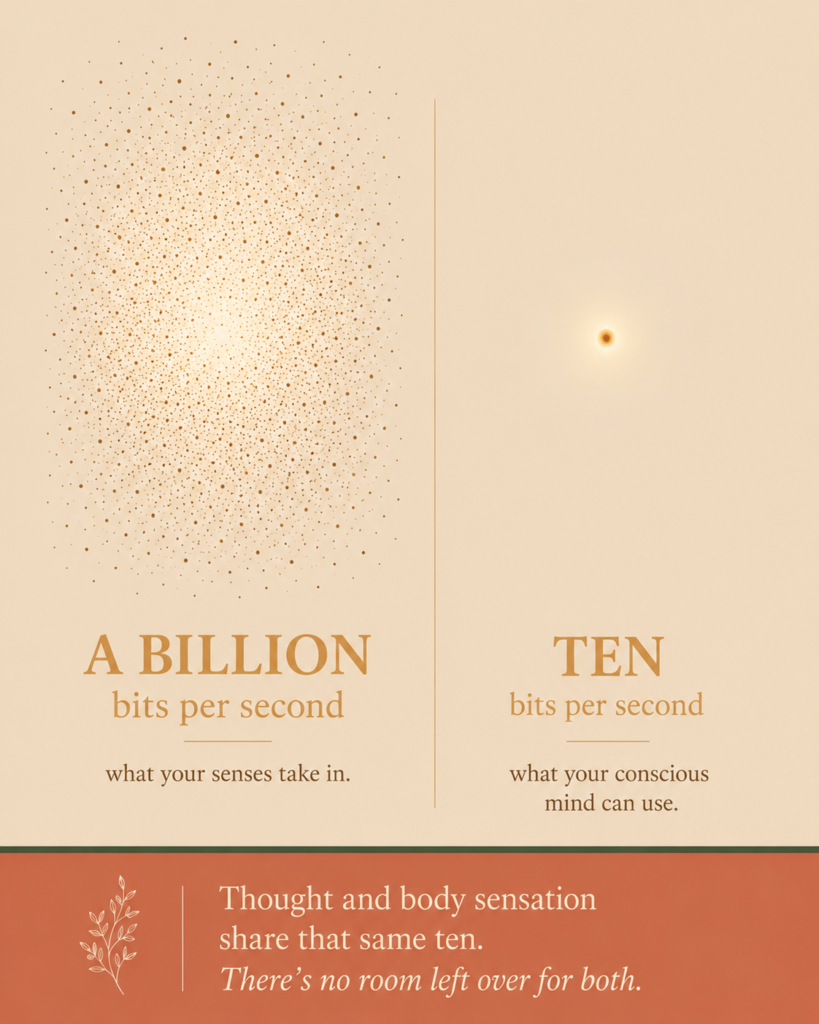
Your skin, your joints, your breathing, your gut — all of it is sending signals continuously. And your senses, taken together, are estimated to take in around a billion bits of information every second. Your conscious mind, according to a 2024 review in Neuron, can only work with about 10 bits per second. This figure has held up across nearly a century of separate measurements in reading, typing, memory, and perception (Zheng & Meister, 2024).
A billion bits arrive. Ten can reach you.
That is not a flaw in the system, but the system is working as designed. A brain that lets all available input through would be unable to function. But it does mean that almost everything your body offers you at any given moment is filtered out before you notice it.
Key Takeaways
- Your senses take in roughly a billion bits of information per second, but your conscious mind can only work with about ten bits at any moment — this is the entire budget for whatever you’re aware of, be it thought or sensation (Zheng & Meister, 2024).
- Thought and bodily sensation compete for that same ten-bit budget. When the mind is caught in a thought, there’s nothing left for anything else.
- Turning a worry over and over again is like scratching an itch. It brings brief relief, and it strengthens the pattern it’s trying to relieve.
- Bringing attention back to your body activates a different part of the brain, and with practice, it becomes easier to return to.
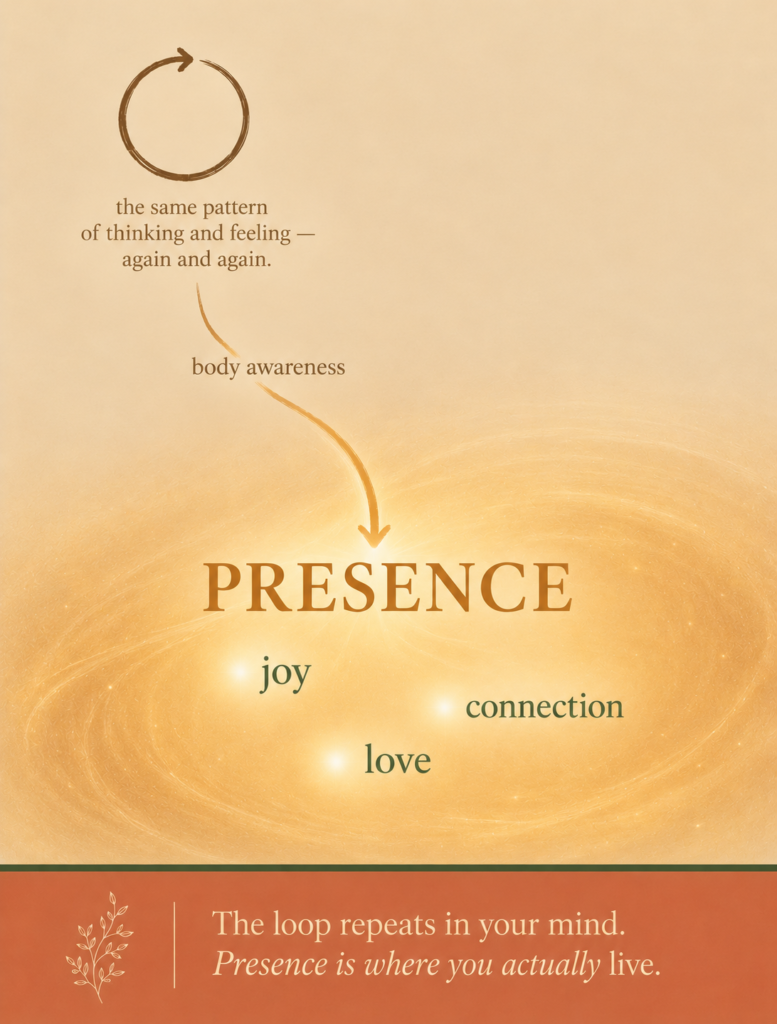
- Being in the present moment isn’t only a relief from overthinking — it’s where joy, love, and connection are actually felt. That’s part of why the practice is worth training
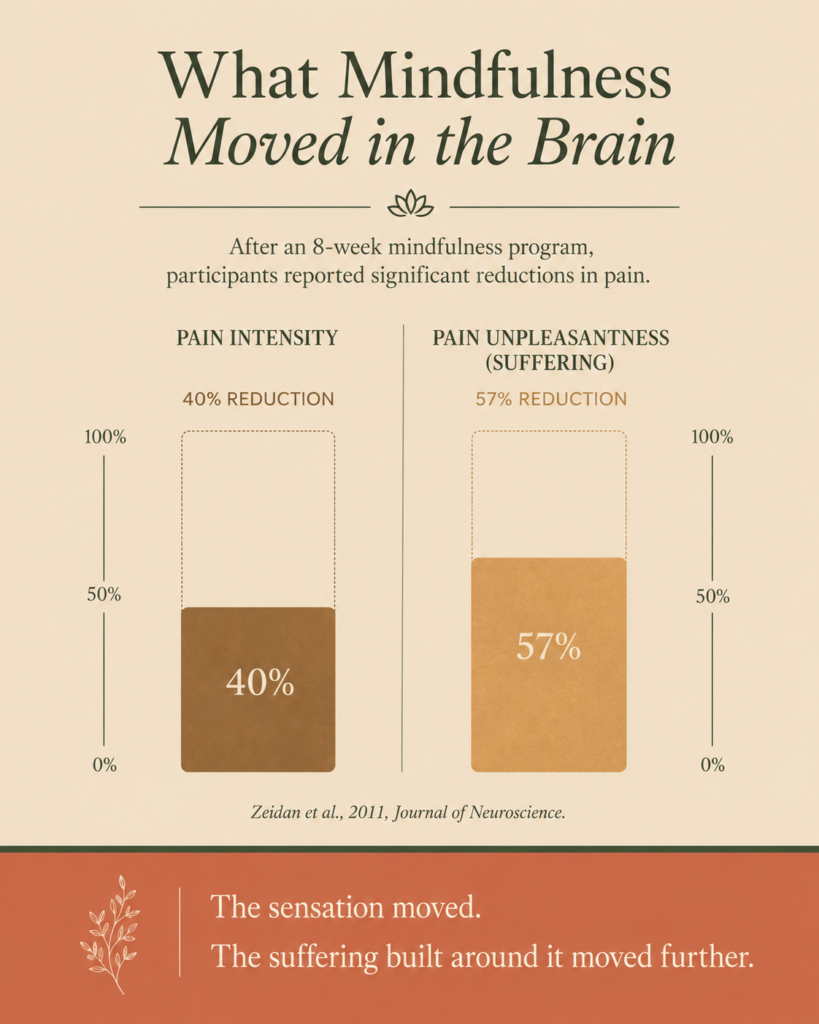
- Research on pain shows something specific and useful: a meditative practice can significantly reduce both the intensity of pain and the suffering built around it, with the suffering easing the most. This is close to the difference between pain and suffering from pain.
- Doing this with warmth toward the body works against the low-level criticism most of us carry toward our own bodies and moves toward self-love — the much-needed unconditional self-love.
Where the ten bits go
Ten bits a second is the mind’s entire budget — the whole of what you can be consciously aware of, in any form, at any moment. Feeling the weight of your feet on the floor uses some of that budget. So does a passing thought. They are not stacked on top of each other. They are two uses of the same ten bits, and only one can be spent at a time.
Which means that when the mind is caught in a thought, the body isn’t background noise you’re failing to notice. There’s simply nothing left in the budget to notice it with. This is not a mind ignoring signals it has room for. It’s a mind that has already spent its entire capacity elsewhere.
For a lot of us, that somewhere else is thought. And often, it can be a recurring thought about things that are not happening right now. A large-scale study using experience sampling found that people’s minds wander from the present nearly half the time across almost every activity measured, and that this wandering tends to make people less happy than they would be if their attention stayed where they were (Killingsworth & Gilbert, 2010).
This kind of thinking runs through a specific set of brain regions, known as the default mode network, that are active by default when we are not focused on a task. A 2024 systematic review of 36 imaging studies found that rumination is consistently associated with increased connectivity within this network, along with altered coordination between it and the networks responsible for cognitive control and for flagging what deserves attention (Misir et al., 2024). One part of this circuit, connecting a region involved in mood regulation to the default network’s self-referential hub, appears repeatedly in depression research and has been described as a functional pairing well suited to producing exactly this kind of looping (Hamilton et al., 2015).
There is a second system worth naming because it explains why these patterns feel automatic rather than chosen. Habits, including habits of thought, are built and run through circuits in the striatum, and research on this system shows a shift over time from goal-directed, deliberate processing to something closer to a fixed routine, one that runs with less and less conscious input the more it is repeated (Balleine & O’Doherty, 2010). This is what circuits built for efficiency do.
Why going over it again doesn’t help
Here is an analogy that captures this better than most explanations of default mode activity do.
When something itches, the response is almost automatic. We scratch, and for a moment it helps. The relief is brief, and the cost adds up. Scratching activates a reward circuit in the brain, making us want to do it again (Yang et al., 2025). It also further irritates the skin, so the itch returns stronger than before (Renkhold et al., 2023).
Our attention works in a similar way. When something is troubling us, we go over it again. It feels like the responsible thing to do, as if the problem might finally give way if we look at it one more time. It rarely does. Going over it again strengthens the same pathway in the brain, so the thought comes back more easily the next time.
The urge to scratch and the urge to ruminate over negative thoughts or emotions turn out to share more than a metaphor. Both engage the brain’s reward circuitry, and both have been described in the research literature as sharing a neurobiological structure with addiction — a cycle that continues not because it works, but because the relief, brief as it is, is real (Ishiuji, 2019).
Bringing attention back to the body
If thinking about the problem again is the itch, what is the alternative?
The body itself. Specifically, the felt sense of it — sensing from within.
This has a name in neuroscience: interoception, the sense of the body’s internal state. According to a widely cited review by neuroanatomist A.D. (Bud) Craig, the anterior insula, a region toward the front of the brain, tucked beneath the temporal lobe, re-represents interoceptive signals from across the body, and this re-representation may form the basis of subjective feeling itself, including emotion (Craig, 2009).
There is direct evidence that doing this changes brain activity in the moment. A well-known study using fMRI compared experienced meditators to novices during several forms of meditation, including loving-kindness practice, and found that the main hubs of the default mode network, the regions implicated in rumination, were relatively quiet in the meditators, and that this quieting was linked to their own reports of a reduced tendency to mind-wander (Brewer et al., 2011).
The same shift can be trained. It does not require decades of practice. It requires attention, redirected again and again, toward the body and the present moment rather than toward the loop.
There’s a reason this matters beyond quieting the loop. Joy, love, and connection can happen only in the present moment. Not in replaying what happened. Not in rehearsing what might. The mind can revisit a memory or run through a plan, but it can experience only the present. That’s part of why training attention to return to the present, again and again, is worth the effort beyond just feeling calmer. It’s the only place where any of the good things are actually available to be felt. And we are less happy exactly when our minds wander, regardless of what we are doing at the time (Killingsworth & Gilbert, 2010).
Pain, suffering, and what the research actually shows
Some years ago, I went through a period of persistent physical pain, and for a long stretch, I could not sleep.
I knew that a large part of what I was experiencing was not the pain itself. It was suffering built around pain: the wanting it gone, the checking in on it, the dread about the night ahead. This is true both for physical pain and emotional distress.
I also knew that when something in the body hurts, it seems to be asking for love and care – attention of the kind you’d give someone you’re looking after.
That was the whole insight, and it’s what I started doing. What happened: the suffering eased, and I was able to sleep.
What research can say, with more precision than my own experience, is that the pain and suffering from pain are not the same thing and are independent of each other. In a study using brief meditation training, participants who meditated during a painful stimulus showed a 57% reduction in how unpleasant the pain felt and a 40% reduction in how intense it felt (Zeidan et al., 2011). Both numbers matter. The sensation moved. The suffering built around it moved further. I believe I experienced the same, even though I have no measurement of my own, only the nights I slept through.
I later recorded that same instinct for my clients, as Healing Love, because it turned out that very few of the people it helped were dealing with physical pain at all. Most were simply living several steps behind or ahead of their own bodies, all day, every day, the way most of us do.
Why love, and not just scanning
A body scan on its own is a useful tool. Attention moves through the body, part by part, and that alone interrupts the default network’s usual activity.
But there’s something worth naming about how most of us relate to our own bodies, because it changes what a scan does. Our culture holds the body to constant comparison: against ideals, against what it used to look like, or against what it should look like. Many of us carry an ongoing, low-level criticism of some part of our body, or of our body as a whole, and that criticism shapes how willing we are to actually feel what’s happening inside it.
Warm attention is what works against that. It asks you to notice each part of your body for what it is and how it feels. Your body deserves it for all it does for you. And what it does is hard to summarize in a sentence, because even a small, ordinary movement is the visible result of an enormous amount of invisible coordination.
Lifting a finger calls on nerves, muscles, and blood vessels working together in a sequence you’ve never had to think about. Inside a single cell, thousands of chemical processes run at once, all of them happening below anything you could consciously track. And at the scale of the whole body, replacement never stops: roughly 330 billion cells are replaced every day, most of them blood and gut lining cells (Sender & Milo, 2021). Skin renews within weeks. Blood cells last around four months. The skeleton rebuilds itself over roughly a decade. None of it stops while you’re absorbed in a thought, and none of it was ever something you had to ask for.
Meeting that with warmth, rather than with the low-level criticism most of us default to, is a part of what self-love actually looks like in practice — not as a phrase on a mug, but as a specific, repeatable act of attention. It’s something a lot of people have never really done for themselves, deliberately, for ten minutes at a time. That’s the larger part of what this practice offers, and it goes well beyond whether the habit sticks.
There’s also a practical reason why loving attention matters beyond how it feels. Research on learning consistently finds that reward improves how well something is retained. Reward, paired with practice, improves the consolidation of a skill in a way that punishment or neutral feedback does not match (Johnson et al., 2022). This is why practicing warm attention can help you develop the skill of staying connected with your body and the present moment.
What the Body Does When It’s Finally Allowed To
Getting into a state of deep relaxation is the first part of what Healing Love does. In hypnotherapy, that opening part has a specific name: the induction, the process of guiding someone from ordinary waking attention into a deeper, more receptive state. A few minutes of induction is the doorway to that state.
This part of the recording doesn’t depend on anything else it does. The relaxed state itself is where the value starts.
That length has a purpose. Recent research proposes that contemplative practice can produce a distinct physiological state of “deep rest,” in which the body redirects energy away from stress processes and toward cellular repair, largely by signaling safety to the nervous system (Crosswell et al., 2023).
The reverse also holds: when the mind stays in rumination and the body remains disconnected from it, the systems that would otherwise carry out this repair can be interrupted, sometimes for long stretches at a time. Staying in the relaxed state for the length of the recording gives the body enough time to actually reach that state and to do the quiet repair work it can only do when nothing is asking it to be on guard.
From one moment, to a day, to a life
The recording itself takes about thirteen minutes. During that time, it interrupts the loop, giving the nervous system a rest.
What compounds is the return. The people I’ve seen benefit most from this practice are not the ones who do it once. They’re the ones who, over days, start noticing the loop earlier, sometimes mid-thought, and find they can bring themselves back to their body for a few seconds in the middle of an ordinary day.
A few seconds of attention to the body, repeated many times across a day, add up. Each time is a small vote for where attention goes by default. Over weeks, that default starts to shift on its own.
A reflection, before you decide
Notice, right now, whatever you can feel in your body without changing anything about it: the weight of where you’re sitting, your hands, your breathing. Stay with it for ten seconds. That’s the whole practice, in miniature.
If that felt like something you’d like more of, especially at the end of a day that’s spent too much time in your head, Healing Love was built for exactly that.
A note on what this is and isn’t. Healing Love is a rest-and-attention practice, not a medical treatment. It doesn’t diagnose, treat, or replace care for the cause of physical pain.
If you have pain that’s new, worsening, or unexplained, please have it assessed by your doctor.
It is also not designed to resolve deep or long-standing psychological difficulties; those deserve real therapeutic work, not fifteen minutes of audio. What it does, reliably, is rest the body and brain and train it to return to the present. That’s a genuinely useful thing on its own, and it’s what it’s built to do.
FAQ: How to Stop Overthinking and Come Back to Your Body
What is the difference between pain and suffering in this context?
Pain is the sensation itself. Suffering is what builds around it: the resistance, the dread, the constant monitoring. Research on brief meditation training found that both pain and pain unpleasantness dropped in intensity during the practice (Zeidan et al., 2011).
Why does overthinking feel productive if it isn’t helping?
Because turning a problem over again engages the brain’s reward circuitry in a way that feels like progress, similar to the temporary relief of scratching an itch. The system that makes rumination feel worthwhile is not built to tell you whether it’s actually working.
What is body scan meditation, and is this the same thing?
A body scan is attention moved deliberately through the body, part by part. That’s the underlying structure, and it’s what most guided recordings mean by the term. What appears to matter beyond that structure is the quality of attention brought to it. Meeting the body with warmth, rather than the low-level criticism most of us default to, is close to how self-love actually can be expressed in practice. There’s also a practical side: research on learning suggests rewarding practices are retained better than neutral or punishing ones, so warmth may help you develop a habit of your body awareness and presence in the moment.
Do I need to be in physical pain for this to help?
No. Most people this practice has helped were not dealing with physical pain. The more common pattern is simply spending most of a day disconnected from the body, absorbed in thought — a pattern this practice is built to interrupt regardless of its cause.
How is this different from therapy?
It isn’t a replacement for it. This practice rests the brain and trains a return to the present moment. It isn’t designed to resolve deeper psychological patterns, and if something in you needs that kind of work, this is a good complement to it, not a substitute.
Can this help with overthinking at night, when I can’t sleep?
That’s close to how the practice began. Lying awake with a mind that won’t stop circling is a very literal version of the pattern this article describes: thought using the entire budget of attention, with nothing left for the body and the present moment. Bringing attention back to physical sensation is what let me sleep a few years ago. My own sense is that the same thing is at work whether it’s physical pain or emotional distress keeping you up.
How often should I use it?
Daily, if you can, at least while you’re learning the practice. The effect that compounds: noticing the loop earlier, returning to the body more easily during the day, depends on repetition more than on any single session.
References
- Zheng, J., & Meister, M. (2024). The unbearable slowness of being: Why do we live at 10 bits/s? Neuron. https://doi.org/10.1016/j.neuron.2024.11.008
- Killingsworth, M. A., & Gilbert, D. T. (2010). A wandering mind is an unhappy mind. Science, 330(6006), 932. https://doi.org/10.1126/science.1192439
- Mısır, E., Hoşgören Alıcı, Y., & Kocak, O. M. (2024). Functional connectivity in rumination: a systematic review of magnetic resonance imaging studies. Journal of Clinical and Experimental Neuropsychology, 45(9), 928–955. https://doi.org/10.1080/13803395.2024.2315312
- Hamilton, J. P., Farmer, M., Fogelman, P., & Gotlib, I. H. (2015). Depressive rumination, the default-mode network, and the dark matter of clinical neuroscience. Biological Psychiatry, 78(4), 224–230. https://doi.org/10.1016/j.biopsych.2015.02.020
- Balleine, B. W., & O’Doherty, J. P. (2010). Human and rodent homologies in action control: corticostriatal determinants of goal-directed and habitual action. Neuropsychopharmacology, 35(1), 48–69. https://doi.org/10.1038/npp.2009.131
- Yang, S., et al. (2025). Beyond the itch: the complex interplay of immune, neurological, and psychological factors in chronic urticaria. Journal of Neuroinflammation. https://pubmed.ncbi.nlm.nih.gov/40069822/
- Renkhold, L., et al. (2023). Scratching increases epidermal neuronal branching and alters psychophysical testing responses in atopic dermatitis and brachioradial pruritus. Frontiers in Molecular Neuroscience. https://pubmed.ncbi.nlm.nih.gov/37795274/
- Ishiuji, Y. (2019). Addiction and the itch-scratch cycle. What do they have in common? Experimental Dermatology, 28(12), 1448–1452. https://doi.org/10.1111/exd.13858
- Craig, A. D. (2009). How do you feel — now? The anterior insula and human awareness. Nature Reviews Neuroscience, 10(1), 59–70. https://doi.org/10.1038/nrn2555
- Sender, R., & Milo, R. (2021). The distribution of cellular turnover in the human body. Nature Medicine, 27(1), 45–48. https://doi.org/10.1038/s41591-020-01182-9
- Brewer, J. A., Worhunsky, P. D., Gray, J. R., Tang, Y. Y., Weber, J., & Kober, H. (2011). Meditation experience is associated with differences in default mode network activity and connectivity. Proceedings of the National Academy of Sciences, 108(50), 20254–20259. https://doi.org/10.1073/pnas.1112029108
- Zeidan, F., Martucci, K. T., Kraft, R. A., Gordon, N. S., McHaffie, J. G., & Coghill, R. C. (2011). Brain mechanisms supporting the modulation of pain by mindfulness meditation. Journal of Neuroscience, 31(14), 5540–5548. https://doi.org/10.1523/JNEUROSCI.5791-10.2011
- Johnson, B. P., et al. (2022). Reward and plasticity: Implications for neurorehabilitation. Handbook of Clinical Neurology. https://www.sciencedirect.com/science/chapter/handbook/abs/pii/B9780128194102000187
- Crosswell, A. D., Mayer, S. E., Whitehurst, L. N., Picard, M., Zebarjadian, S., & Epel, E. S. (2023). Deep rest: An integrative model of how contemplative practices combat stress and enhance the body’s restorative capacity. Psychological Review, 131(1), 247–270. https://doi.org/10.1037/rev0000453
About the Author

Olga Willemsen, Ph.D. > Certified Clinical Hypnotherapist & Transformational Coach
Olga Willemsen is the founder of New Empowered You, where she helps clients work through anxiety, burnout, and stubborn weight struggles using an evidence-based, pragmatic approach. She holds a Ph.D. in Natural Sciences and brings that same grounded mindset to her work in advanced hypnotherapy.
A certified member of the International Association of Counselors and Therapists (IACT), Olga trained in RTT, Neo-Ericksonian Hypnosis, and the Simpson Protocol. Her approach works with the mind’s patterns rather than against them, helping clients shift the habits and beliefs that keep them stuck.
Curious what’s really behind what’s holding you back? Let’s find out together.