

Why do I procrastinate even when I want to do it?
“Why do I procrastinate even when I want to do it?” – genuinely wanting something and still not starting causes a particular kind of frustration. Not because the goal is unclear. Not because you lack information or time. But because something inside keeps pulling you back to the sofa, the scrolling, the “I’ll do it tomorrow.”
That gap between intention and action is one of the most common things I see in my practice. And what strikes me every time is this: the people sitting across from me are not unmotivated. They are, in many cases, intensely motivated and completely stuck.
If you have ever called yourself lazy in that gap, I want to offer you something more useful than self-criticism. The neuroscience of procrastination has a different explanation entirely.
Key Takeaways
- Procrastination is a form of emotional regulation, not laziness. Research consistently shows it functions as a strategy for managing uncomfortable feelings — anxiety, self-doubt, the threat of failure — rather than a time-management failure or character flaw.
- Two brain systems are in conflict. When a task feels aversive or uncertain, emotion and reward circuits (including the amygdala and striatum) can override the prefrontal cortex, the region responsible for planning and self-regulation. This is a biological mechanism, not a personal weakness.
- Emotional avoidance predicts chronic procrastination more strongly than poor planning. Research links persistent procrastination to difficulty regulating negative emotions, more so than to any lack of information, intelligence, or organizational ability.
- Hesitation is a protective response, not resistance. The brain interprets unfamiliar or uncertain goals as potential threats. The voice that says “not now” or “maybe I’m not ready” is the brain’s protective system doing exactly what it was designed to do.
- Personal growth is a fundamental human need. When procrastination blocks that need, self-esteem drops, making it even harder to initiate action. The loop between not starting, self-criticism, and reduced confidence is self-reinforcing and cannot be broken by willpower alone.
- Motivation scales with how immediate a reward feels. Temporal motivation theory (Steel and König, 2006) shows that the further away a payoff, the weaker its pull on behavior. “Walk for 20 minutes after lunch today” generates more motivation than “lose 20 kg by summer.”
- The brain responds to starts, not to plans. Making the next step concrete and tiny activates the reward circuit. The emotional charge around a task typically drops significantly once it has actually begun — the brain is more afraid of starting than of continuing.
- Practical strategies may not reach the root if the underlying belief is “I know what I am not capable of.” When a limiting belief fires automatically, before any conscious strategy can engage, reducing the step size does not resolve the resistance. That pattern requires work at the level of belief.
Procrastination is not a character flaw
The most important reframe the research offers is this:
Procrastination is not a time-management problem or a laziness problem.
It is an emotion-regulation strategy.
When we procrastinate, we are not failing to do the task. We are successfully managing an uncomfortable feeling of anxiety, self-doubt, the threat of failure, and the discomfort of starting something uncertain.
The avoidance works in the short term. The uncomfortable feeling goes away. The relief is real. But the task remains, and with it, a growing weight of guilt that makes starting even harder next time.
Neuroscience research consistently shows that procrastination involves a conflict between two systems in the brain. The prefrontal cortex, the part responsible for planning, long-term thinking, and self-regulation, competes with emotion and reward circuits, including the amygdala and striatum, which are wired to respond to what feels threatening or rewarding in the moment.
When a task feels uncertain, boring, or aversive, the emotion circuits can override the planning system. The brain chooses immediate relief over future benefit. That is not a character flaw but biology.
Research on motivational cognition consistently shows that difficulty regulating negative emotions is one of the strongest predictors of chronic procrastination, more so than poor planning skills or lack of information about the task.
Your brain is trying to protect you
Here is the piece that most procrastination advice misses: the hesitation is not your enemy. It is a protective response.
Your mind operates on two primary drives: it wants to protect you from harm, or it wants to move you toward pleasure. When you hesitate, doubt, or postpone, you are experiencing protection mode. Your brain has assessed the situation: the new goal, the uncertain step, the possibility of failure — and decided that staying where you are is safer.
This makes evolutionary sense. The comfort zone exists for a reason. Unfamiliar territory is where risk lives. The part of you that says “maybe it’s not the right time” or “maybe I’m not ready” is not irrational. It is doing its job. It is trying to keep you safe.
The problem is that in modern life, safety and growth are often in tension. The “risky” thing your brain is protecting you from is frequently the very thing you most want to do: start the business, write the book, change the habit, take the first step toward a goal that matters.
The protection response fires not because the action is genuinely dangerous, but because it is unfamiliar, and unfamiliarity reads as a threat.
Recognizing this changes the approach entirely. You do not need to fight your hesitation. You need to understand what it is protecting you from, and reassure that part of you that it is safe to move.
The self-esteem loop no one talks about
This is where I think the mainstream conversation about procrastination falls short. It focuses almost entirely on productivity and misses the deeper cost.
We have an intrinsic need to grow. Not a preference, not a nice-to-have. A need.
Personal growth is one of the fundamental human needs, and without fulfilling it, we cannot experience genuine satisfaction in life. We are wired to set goals, pursue them, and feel the reward of making progress.
When we fulfill that need, when we do the thing we set out to do, even a small version of it, self-esteem grows. We feel capable. We feel like ourselves. That feeling compounds.
When we don’t fulfill it, the opposite happens. We call ourselves lazy. We tell ourselves we are not the kind of person who follows through. Self-esteem drops. And here is the cruel irony: low self-esteem makes starting even harder, because action requires believing, on some level, that the effort is worth it and that you are capable of doing it.
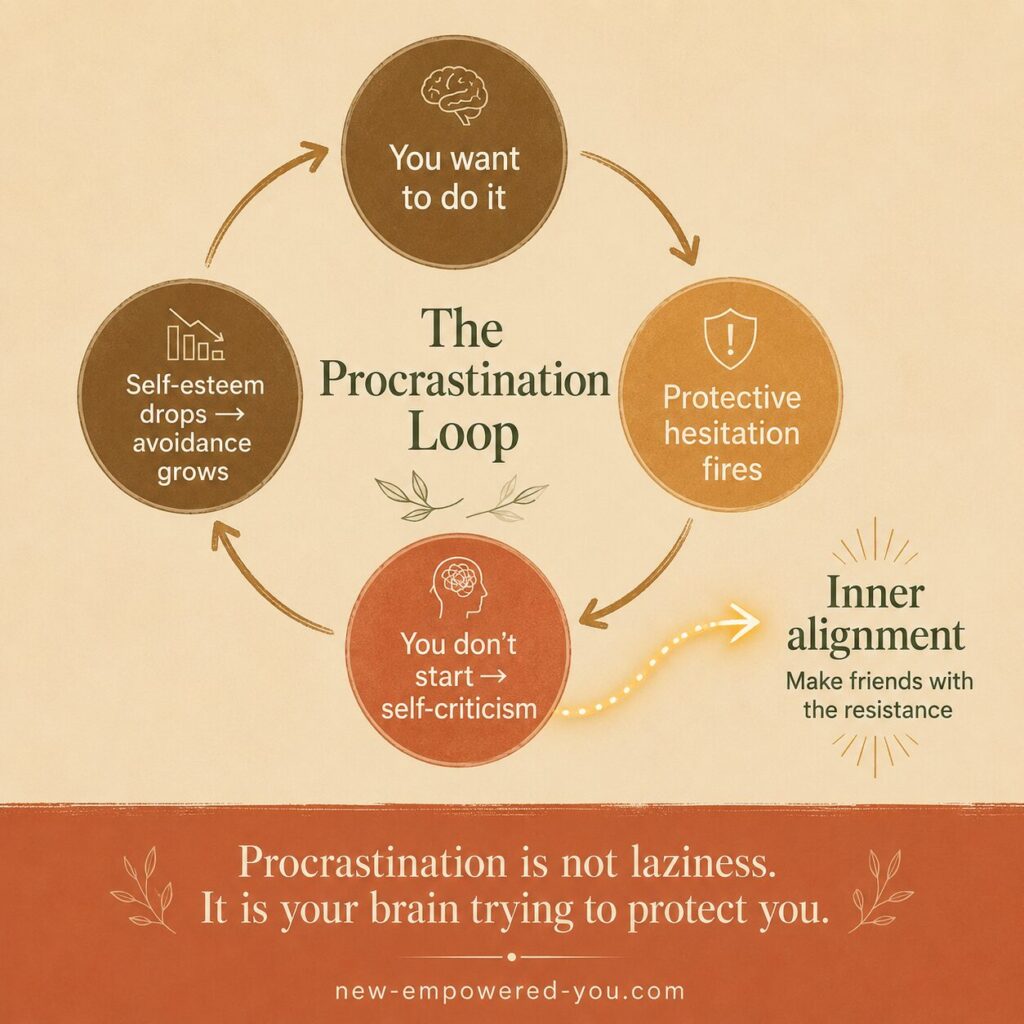
So procrastination can create a self-reinforcing cycle:
- Want to do something → feel protective hesitation → don’t start
- Don’t start → self-critical inner voice (“lazy,” “not good enough”)
- Inner criticism → self-esteem drops
- Lower self-esteem → less confidence to start → avoid even more
Breaking this procrastination cycle does not require willpower. It requires interrupting the loop at the right point.
What neuroscience says actually helps
The brain’s dopamine-based reward system is central to motivation. Dopamine does not simply reward achievement but responds to anticipated reward and to progress.
This is why the size of the step matters so much. A vague, distant goal gives the reward system very little to work with.
A concrete, achievable action that produces visible progress gives it something real.
Research on temporal motivation theory (Steel & König, 2006) shows that motivation scales with how immediate a reward or consequence feels. The further away the payoff, the less pull it has on behavior. This is how deadlines help: they make the consequence feel close. It is also why “I want to lose 20 kg by summer” is a much weaker motivational prompt than “I am going to walk for 20 minutes after lunch today.”
Three things consistently support the prefrontal cortex in winning the tug-of-war against avoidance:
- Making the next step concrete and tiny. Not “work on the project” but “open the document and write two sentences.” The brain responds to starts, not to plans.
- Making progress visible. Completing a small action activates the reward circuit. Noticing completion and pausing to acknowledge it reinforces the motivational pathway.
- Reducing the emotional charge of the task. When an action feels threatening, the protective response fires. Reframing the step as small, reversible, and non-defining removes much of the threat.
None of this is about trying harder. It is about making it easier for the part of you that wants to move to actually move.
Inner alignment — the part that willpower cannot reach
There is something that goes beyond task-management strategies, and it is the piece I work with directly in my practice.
If the protective part of you, the voice that says “not now,” “not me,” “maybe later”, is fighting against your goals, no amount of to-do list redesign will fully resolve the friction. You will keep bumping into the same wall.
What creates lasting momentum is not overpowering that voice but making friends with it. Understanding what it is protecting you from. Offering it reassurance. Allowing the resistance to soften when it no longer needs to be on guard.
When that happens — and in the work I do, I see it happen surprisingly quickly — something shifts. The same task that felt impossible suddenly feels manageable. Not because the task changed, but because the inner conflict dissolved.
The energy that was going into self-protection is now available for action.
This is what genuine inner alignment feels like. Not pumping yourself up or white-knuckling through resistance. A quiet, settled sense of: I want this, and I am going to do it.
A practical place to start
If you want to apply the neuroscience directly to your day, the principles translate into a simple structure:
- In the morning, before checking messages, name your top one to three priorities and write the very next physical action for the first one.
- Work in focused blocks, starting with the highest-priority task while your cognitive energy is at its peak.
- Break each task into the smallest realistic step — small enough that resistance has little room to appear.
- At the end of the day, review what you completed, not only what remains. The brain needs to register progress, or it just carries the weight of the unfinished forward.
I have put together a neuroscience-based daily checklist that walks through this structure in full — morning, focus blocks, midday reset, and evening shutdown — with the reasoning behind each step. Download it here.
A question to sit with
Before you think about the goal you have been postponing, ask yourself this: what is the hesitation protecting you from?
Not what is wrong with you. What does that part of you fear might happen if you actually did the thing? Failure? Exposure? Discovering that you are more capable than you have been told?
The answer is usually more honest and more tender than “I’m just lazy.”
If you would like to go further than reading, the Unstoppable guided hypnosis session was created for exactly this: to work directly with the part of you that holds back, to dissolve the protective friction at its source, and to anchor the feeling of motivated, effortless action in your body so it is there when you need it. You can find it here:
FAQ: Why do I procrastinate?
Is procrastination a trauma response?
It can be. Procrastination is a self-protection strategy: the brain detects something as threatening and generates avoidance to keep you safe. When that pattern is deeply entrenched and appears across many areas of life, it often traces back to experiences that taught the nervous system that attempting certain things is not safe.
This does not mean everyone who procrastinates has experienced trauma. It means that for some people, the hesitation is not about the task at all. It is a protection response running on autopilot, formed earlier and now triggered automatically. Addressing it requires going back to where it was learned.
Which emotion causes procrastination?
Anxiety is the primary driver. Research shows that procrastination is most reliably triggered by tasks that generate anticipated discomfort: anxiety, self-doubt, fear of failure, or fear of judgment — not by tasks that are difficult or time-consuming in themselves. The brain learns to associate certain tasks with negative emotional states and generates avoidance to prevent that discomfort.
The avoidance produces short-term relief, which reinforces the pattern. This is why procrastination tends to strengthen over time without intervention, and why addressing the emotional trigger matters as much as changing the behaviour.
How does procrastination affect your brain?
Procrastination involves a conflict between two systems. The prefrontal cortex, responsible for planning, long-term thinking, and self-regulation, competes against emotion and reward circuits, including the amygdala and striatum, which respond to what feels threatening or rewarding right now. When a task feels aversive, the emotion circuits can override the planning system. That override is not a choice. It happens automatically.
The dopamine-based reward system is also involved. Dopamine responds to anticipated reward and to progress, not only to final outcomes. A distant goal gives the reward system very little to respond to, which is why breaking a goal into immediate, achievable steps changes the brain’s response to it. Each completed step activates the reward circuit and makes the next step easier to begin.
Can hypnotherapy help with procrastination?
Yes. There are always limiting beliefs behind persistent procrastination about what you are capable of, what you deserve, and whether it is safe to be seen succeeding. Working with those beliefs directly, at the level where they are held, can resolve the pattern at its root. Once the belief shifts, the practical steps, such as breaking the goal down and starting small, often follow naturally because the resistance that made them feel impossible is no longer there.
How do I know if my procrastination is a habit or something deeper?
If the same avoidance pattern shows up across multiple areas of life, not just one project or one type of task — and if it is accompanied by significant self-criticism or low confidence, it is likely rooted in something deeper than habit. Habit-based procrastination typically responds well to environmental design and step-breaking strategies. Pattern-based procrastination, rooted in self-worth or protective beliefs, often requires deeper work.
About the Author

Olga Willemsen, Ph.D. > Certified Clinical Hypnotherapist & Transformational Coach
Olga Willemsen is the founder of New Empowered You, where she helps clients work through anxiety, burnout, and stubborn weight struggles using an evidence-based, pragmatic approach. She holds a Ph.D. in Natural Sciences and brings that same grounded mindset to her work in advanced hypnotherapy.
A certified member of the International Association of Counselors and Therapists (IACT), Olga trained in RTT, Neo-Ericksonian Hypnosis, and the Simpson Protocol. Her approach works with the mind’s patterns rather than against them, helping clients shift the habits and beliefs that keep them stuck.
Curious what’s really behind what’s holding you back? Let’s find out together.


