
Ozempic Risks: What the Evidence Actually Shows About the GLP-1 Long-Term Side Effects and Weight Regain
Something shifted in the past two years in how people talk about weight. Ozempic, Wegovy, Mounjaro, Rybelsus: names that, a few years ago, only endocrinologists used are now part of everyday conversation. Ozempic risks, as well as other GLP-1 drug risks, are not getting the same attention as their results.
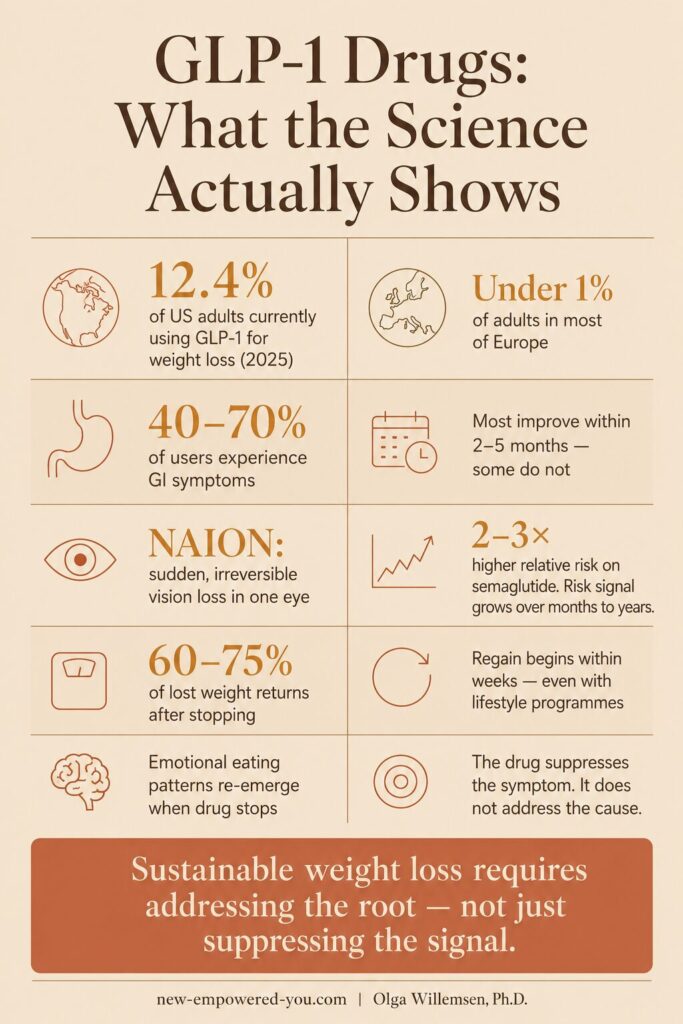
In the United States, 12.4% of adults reported currently using a GLP-1 medication (Glucagon-Like Peptide-1) specifically for weight loss by late 2025, up from 5.8% in early 2024 (Statista, 2025). In Europe, the numbers are much smaller, still under 1% in most countries, but the trajectory is steep and the media coverage even steeper.
If you are one of the millions of people weighing this option, or you know someone who is, this post is for you. I want to give you the same balanced, research-grounded picture I wish more mainstream sources would provide:
- what these drugs actually do
- what the evidence says about serious risks (including ones that appear or worsen months to years into treatment)
- what happens to your weight when you stop, and
- why the biological and psychological story behind obesity so often gets left out of the conversation.
Key Takeaways
- GLP-1 use is growing fast, but insurance coverage for weight loss is limited. By late 2025, 12.4% of US adults were using GLP-1 medication for weight loss. In most of Europe, use remains below 1%, and public insurance rarely covers weight-loss indications. In the Netherlands, Wegovy was not included in the basic insurance package as of 2025.
- Gastrointestinal side effects are common and can persist. Between 40 and 70% of users experience nausea, vomiting, or other digestive problems. Around 10% to 20% stop the medication because symptoms do not resolve. A smaller subset develops gastroparesis, a condition with more than double the risk compared to other weight loss approaches.
- Sudden, permanent vision loss is a confirmed, rare risk that grows with the duration of use. Non-arteritic anterior ischaemic optic neuropathy (NAION) causes irreversible vision loss in one eye. Both the WHO and the European Medicines Agency confirmed the association in 2025. The risk signal increases over months to years.
- Most of the weight lost returns after stopping, often within weeks. Across multiple systematic reviews and meta-analyses, 60 to 75% of lost weight returns after discontinuing GLP-1 medication. Regain begins within weeks and occurs even when structured lifestyle programs are maintained. This means most people would need to stay on the medication indefinitely to fully preserve their results.
- GLP-1 drugs appear psychologically safe during treatment, but do not address the drivers of emotional eating. Multiple trials report improved mental wellbeing on treatment. A pharmacovigilance signal for suicidal ideation was investigated but not causally confirmed, and rates of actual suicide attempts were lower among GLP-1 users than comparators. However, the psychological and emotional patterns that drive overeating are suppressed rather than resolved. When the drug stops, those patterns return alongside the weight.
- Type 2 diabetes can go into remission through intensive lifestyle change for a meaningful proportion of people, particularly early in the disease. A 2022 meta-analysis found that intensive lifestyle interventions achieved remission in 40% to 60% of people with recent-onset type 2 diabetes. Weight loss of approximately 15 kilograms leads to remission in around 80% of people with obesity and early disease. A 2025 clinical guideline from the American College of Lifestyle Medicine formally endorses lifestyle intervention as a first-line treatment for remission. GLP-1 drugs manage the condition pharmacologically. Addressing the lifestyle drivers alongside medication treats the whole problem, not only its expression.
- Both bariatric surgery and GLP-1 drugs leave the root cause of obesity unaddressed. Research has documented the emergence of new compulsive behaviors in a subset of people after bariatric surgery, when food can no longer serve its emotional function. GLP-1 drugs create a comparable dynamic pharmacologically. Addressing the psychological and emotional drivers of eating alongside any medical or surgical intervention improves long-term outcomes.
What GLP-1 Drugs Do, and Why They Work
GLP-1 receptor agonists (semaglutide in Ozempic and Wegovy, liraglutide in Saxenda, tirzepatide in Mounjaro) mimic a hormone your gut releases after eating. They:
- slow the emptying of your stomach
- reduce appetite signals in the brain and
- dampen the reward response to food
For people with obesity, particularly those who also have type 2 diabetes, the results in clinical trials have been meaningful: an average of 10 to 15% body weight loss over the course of a year, which is more than any previous approach outside of surgery had achieved at scale.
That result is real, and it matters. Obesity is associated with serious health consequences, including cardiovascular disease, type 2 diabetes, joint damage, and depression.
There is important context for the largest group of people prescribed these drugs: those with type 2 diabetes. Research now demonstrates that type 2 diabetes is substantially a lifestyle-modifiable condition and that it can go into remission through intensive lifestyle change, particularly in the earlier years of the disease.
- A 2022 meta-analysis of nearly 4,000 patients found that intensive lifestyle interventions significantly increase the likelihood of diabetes remission compared with usual care, with very low-calorie approaches achieving remission in 40 to 60% of people with recent-onset type 2 diabetes (Zhang et al., 2022).
- Weight loss of approximately 15 kilograms can lead to remission in around 80% of people with obesity and relatively recent type 2 diabetes (Magkos et al., 2020).
- A 2025 clinical practice guideline from the American College of Lifestyle Medicine formally endorses intensive lifestyle intervention as a first-line treatment path for type 2 diabetes remission (Rosenfeld et al., 2025).
This means that prescribing medication for a condition without simultaneously addressing the lifestyle factors that drive it is treating only part of the problem.
At the same time, real weight loss results achieved with GLP-1 drugs come with real risks. And some of those risks look different depending on how long you have been taking the medication.
The Side Effects Most People Experience
The most common side effects of GLP-1 drugs are gastrointestinal, and they affect a striking proportion of users. Across systematic reviews, 40 to 70% of people on these medications experience:
- nausea
- vomiting
- diarrhoea
- constipation
- bloating or
- early satiety at some point during treatment (Saha et al., 2025).
For most users, these symptoms peak within the first 8 to 20 weeks, especially during dose escalation, and then lessen. Slowing down the dose titration schedule and adjusting meal composition helps many people manage them (Yılmaz & Bastemir, 2026).
But “most people improve” is not the same as “everyone improves.”
Between 10% and 20% of participants in diabetes trials discontinued the medication specifically due to persistent GI symptoms, and similar or higher rates may be expected in non-diabetic settings (Ismaiel et al., 2025).
And for a smaller subset, the digestive consequences are more serious and more lasting than the usual nausea.
A 2026 study from the University of Pennsylvania used AI to analyze more than 400,000 Reddit posts from nearly 67,000 self-reported GLP-1 users — one of the first large-scale real-world analyses conducted entirely outside a clinical trial setting. Among this group, 43.5% described at least one side effect. Gastrointestinal symptoms dominated: nausea (36.9%), fatigue (16.7%), vomiting (16.3%), constipation (15.3%), and diarrhea (12.6%) (Sehgal et al., 2026, Nature Health). The close match with clinical trial rates was read by the researchers as confirmation that the method was capturing a genuine signal.
Two findings went beyond the standard clinical trial picture:
- Fatigue ranked second overall, at a rate higher than would be expected based on clinical trial reporting.
- And menstrual irregularities were reported by nearly 4% of users in the sample — a figure that would be substantially higher in a female-only analysis.
The researchers noted that GLP-1 drugs act on the hypothalamus, which regulates reproductive hormone signaling. Menstrual disruption is also a well-established consequence of rapid caloric restriction and inadequate nutrient intake, both of which accompany GLP-1-driven weight loss. Whether the primary mechanism is hormonal, nutritional, or a combination remains an open question. The Reddit data establishes that this is a common complaint.
The Rarer GLP-1 Risks: What the Evidence Shows Over Longer Exposure
Gastroparesis and intestinal obstruction
GLP-1 drugs work partly by slowing gastric emptying, the rate at which food moves from your stomach into the small intestine. This is how they create a sense of fullness that persists. But in some people, that slowing goes beyond what is comfortable or medically safe.
Real-world data show that GLP-1 use is associated with a more than doubled risk of gastroparesis compared with other weight-loss approaches (Cervantes et al., 2022). Symptoms include weeks of severe nausea and vomiting, inability to keep food down, and significant weight loss from malnutrition rather than from the intended metabolic process.
Case reports document patients requiring hospitalization, intravenous nutrition, and, in some cases, being unable to return to GLP-1 therapy (Deirmenjian & Dagher, 2024).
The FDA updated Ozempic’s labeling to acknowledge reports of intestinal obstruction (ileus) and is monitoring cases of gastroparesis (CBS News, 2024). Because semaglutide has a long half-life, symptoms can persist for weeks even after stopping the drug.
Sudden, irreversible vision loss
This is the GLP-1 risk that has generated the most recent legal attention, and it deserves careful, accurate framing.
Non-arteritic anterior ischaemic optic neuropathy (NAION) is a condition in which the blood supply to the optic nerve is suddenly disrupted. The result is sudden, painless vision loss in one eye, and it generally cannot be reversed. There is no treatment that restores eyesight once it is lost.
Multiple large observational studies and pharmacovigilance analyses now consistently link semaglutide use to NAION. In cohorts of people with type 2 diabetes, semaglutide users faced approximately 2 to 3 times the relative risk of NAION compared to people on other diabetes medications, with an absolute rate of roughly 15 to 27 cases per 100,000 person-years (Liu et al., 2025; Grauslund et al., 2024; Cai et al., 2025). The absolute numbers are low. The irreversibility of the outcome is not.
What is particularly important is the timing. Events often appear from months to approximately two years after starting semaglutide, and some analyses suggest the risk signal continues to increase beyond the two-year mark (Liu et al., 2025; Simonsen et al., 2025). A person who reads their medication leaflet at month one is looking at a different risk profile from the one that applies at month twenty-four.
What regulators have done:
- The World Health Organization formally confirmed the NAION association in June 2025 (WHO, 2025).
- The European Medicines Agency concluded that NAION is a very rare but real side effect and updated the product information for all semaglutide medicines accordingly (EMA, 2025).
- The US Food and Drug Administration (FDA) issued a formal warning letter to Novo Nordisk specifically for failures in postmarketing adverse-event reporting, the legal obligation to notify regulators of safety events that occur after a drug is approved (2-Minute Medicine, 2025).
Anyone on semaglutide who notices any change in their vision should seek medical care immediately and discuss with their doctor whether to continue the medication.
Neurological complications from rapid weight loss
A separate category of neurological risk is less about the GLP-1 drug itself and more about what the drug does so efficiently: it causes rapid, significant weight loss, often accompanied by severe nausea and reduced food intake. This can create the conditions for nutritional deficiency, most critically of thiamine (vitamin B1).
Multiple case reports describe patients on semaglutide developing Wernicke encephalopathy, a serious brain disorder caused by thiamine deficiency. Symptoms included confusion, impaired eye movements, and gait difficulties, along with MRI-visible lesions in brain structures (Gras et al., 2025; Zahir et al., 2025).
One detailed case also documented severe nerve damage throughout the body, with persistent weakness and neuropathic pain, linked to the combined effects of rapid blood sugar changes and malnutrition.
A large US cohort study of more than 20,000 semaglutide users found no increased rate of major neurological diagnoses overall compared to other diabetes drugs (De Giorgi et al., 2024), which puts these cases in an appropriate context: rare, but real, and almost always connected to the downstream consequences of rapid weight loss rather than to direct drug toxicity.
Signals that require longer follow-up
The research community has also flagged possible signals for thyroid cancer risk and bone loss in older adults with GLP-1 use. Both are the subject of ongoing pharmacovigilance (Long et al., 2024; Min et al., 2025).
GLP-1 drugs have been used on a large scale for weight loss in people without diabetes for only a few years. No 10- or 20-year safety data exist for this group yet. Anyone making a long-term commitment to this medication is doing so before that information is available.
What the evidence shows about psychological effects
GLP-1 drugs act not only on the gut but also on reward circuits in the brain, including areas where dopamine signals regulate motivation and the pull toward pleasurable experiences (Himmerich, 2025). This is part of why they reduce cravings and food-seeking behavior beyond simple caloric restriction.
For most users, the evidence on psychological safety during treatment is broadly reassuring. Several trials have reported improvements in patient-reported mental wellbeing, and a 2026 review of lifestyle, pharmacological, and surgical obesity interventions found that GLP-1 receptor agonists improved mental health quality of life across multiple studies (Osborne & Abdelgadir, 2026).
Early pharmacovigilance reports raised questions about a possible link to suicidal ideation, and regulators investigated. Subsequent large cohort studies found a causally unresolved and mixed picture: while reporting rates of suicidal ideation were elevated in some analyses, rates of actual suicide attempts and completed suicides were significantly lower among GLP-1 users than among comparator groups, and no causal relationship has been established (McIntyre et al., 2024; Osborne & Abdelgadir, 2026).
There is an important distinction worth holding onto here: “psychologically safe during treatment” is not the same as “addresses the psychological drivers of obesity.” GLP-1 medications were not designed to do the latter, and they do not.
The brain’s food-reward pathways and emotional-eating patterns are quieted while the drug is active. Once it stops, they return. The weight-regain data in the next section reflects, in part, exactly that return.
The Cost and Access Reality
In most of Europe, GLP-1 medications prescribed for weight loss (as distinct from those used to manage type 2 diabetes) are not covered by public health insurance.
Branded list prices across European markets typically range from €90 to €450 per month, and the realistic out-of-pocket cost for private weight-loss treatment typically falls in the €100 to €400 range, depending on the drug and country (healthsystemtracker.org).
In the Netherlands, Ozempic has a list price of approximately $203 per month and Wegovy approximately $296 per month at the maintenance dose, but as of 2025, Wegovy had not been included in the basic insurance package, meaning most patients pay out of pocket (dutchnews.nl, 2025).
Reimbursement, where it exists, is tied to specific clinical criteria rather than to weight loss as a goal. In the Netherlands, GLP-1 drugs are covered through the standard medicines reimbursement system for type 2 diabetes only under defined conditions, including a BMI of at least 30 with inadequate blood glucose control on metformin and a sulfonylurea (Zorginstituut Nederland, 2019). For obesity without diabetes, reimbursement is the exception rather than the rule.
Saxenda qualifies only for adults with an extremely high weight-related health risk who are not yet eligible for metabolic surgery and who have completed at least one year in a recognized lifestyle program (goodweigh.nl, 2025).
If weight gain was triggered by antidepressants or another medication, that fact alone does not create a separate reimbursement right under current Dutch rules. The decision is still based on the standard diabetes or obesity criteria (nhg.org, 2025).
One distinction many people miss at the outset: “approved” and “reimbursed” are not the same thing. A drug may be available by prescription while remaining entirely out of pocket for you personally. And given that the drug, for most people, only works while you take it, the ongoing cost calculation is worth thinking through carefully before you begin.
What Happens When You Stop: The Rebound Problem
Clinical trials now provide a consistent and sobering picture of what happens after people stop GLP-1 medication. Across multiple systematic reviews and meta-analyses, 60 to 75% of lost weight returns over time after stopping, and the regain can begin within weeks (Quarenghi et al., 2025; Wu et al., 2025; Budini et al., 2026). For people who lost the most weight on the drug, the rebound tends to be the largest.
The reasons are partly biological. When you lose weight, your body responds with a cascade of hormonal adaptations:
- leptin falls (the hormone that signals fullness)
- ghrelin rises (the hormone that drives hunger) and
- overall energy expenditure decreases
These are survival mechanisms that evolved to push weight back toward what the body has decided is its set point. GLP-1 drugs suppress these drives during treatment. When you stop, the drives return in full (Ahmed, 2024; Tzang et al., 2025).
But there is also a psychological layer that the research is beginning to name explicitly. GLP-1 therapy reduces emotional eating and uncontrolled eating while you take it. Neurobiological reviews describe how food cues and reward responses become more prominent again after stopping, promoting what researchers call stimulus-driven overeating (De Melo Nogueira & Sousa, 2026). One review identifies “psychological factors like emotional overeating and dependence on the drug” as direct contributors to rebound obesity after stopping (Al-Shammaa et al, 2025).
Structured exercise and dietary changes can reduce (but rarely prevent) weight regain. One trial found that people who had exercised alongside GLP-1 treatment maintained more of their weight loss one year after stopping the drug than those who had relied on the drug alone, because physical activity behaviors can be sustained, whereas appetite suppression cannot (Jensen et al., 2024). But across systematic reviews, the verdict is consistent: “weight regain occurred regardless of lifestyle interventions,” and GLP-1 drugs likely require chronic use to fully maintain losses (Berg et al., 2025).
The implication is one that not enough people are told at the outset: to maintain the results, most people would need to stay on the medication indefinitely. That means living with:
- an ongoing risk calculation
- a substantial ongoing cost and
- a continuing exposure to the side effects described above.
Before GLP-1, There Was the Surgeon’s Table
It is worth stepping back and putting GLP-1 drugs in a historical context. A decade ago, bariatric surgery (gastric sleeve, gastric bypass) was the most powerful tool available for people with severe obesity who had not responded to other approaches. It produced significant weight loss for many people. It also, for some of those people, exchanged one problem for another.
What the research on bariatric surgery has documented, and what I observe in my clients who come to me after having had surgery, is the emergence of new compulsive behaviors.
A synthesis of the research published in Obesity Reviews, drawing on multiple lines of evidence including neuroimaging and prospective studies, specifically identifies increased alcohol use and other reward-seeking behaviors as documented complications in a subset of post-surgical patients, and links this to the changes surgery makes in the brain’s reward system rather than in the stomach alone (Ivezaj et al., 2017).
The operation does not change the underlying relationship with food, with the body, or with the feelings that were driving the eating in the first place.
When eating can no longer serve the same emotional function, it is not unusual for another behavior to step into that role: alcohol, compulsive shopping, or other ways of managing what has not yet been processed or resolved.
This reflects something the research on adverse childhood experiences (ACEs) has shown repeatedly.
When emotional pain, a deep sense of emptiness, or a belief of not being safe or not being fully loved has not been resolved, the body and brain will find a way to manage it. Food is one outlet. Remove that outlet without addressing what it was managing, and the underlying driver remains, looking for another door.
The same logic applies to GLP-1 drugs. A medication can reduce appetite, quiet food cravings, and produce measurable weight loss. What it cannot do is identify and resolve why food was playing the role it was playing in someone’s life. It cannot change the relationship a person has with their own body. It cannot teach the nervous system that it is safe to live without the numbing that comes from eating beyond physical hunger.
What Sustainable Change Actually Requires
After years of working with people whose weight history is long and complicated, a pattern becomes very clear. The people who reach a weight that feels right for their body and who stay there without constant vigilance or indefinite chemical regulation share something in common. They have addressed the relationship between their inner world and their eating behavior, not only the eating behavior itself.
This means understanding which emotional states trigger eating beyond hunger: loneliness, anxiety, boredom, and the feeling of not being enough. It means working through early experiences, often from childhood, that taught the nervous system the world is not safe and the body is not to be trusted. It means building a healthy, positive relationship with the body and food.
Integrative hypnotherapy, the approach I use, combining advanced methods working on the subconscious mind, is one of the tools that can access this deeper layer. Much of what drives overeating operates below conscious awareness: in emotional associations, early imprints, and survival strategies that made sense in childhood but no longer serve the adult.
A pattern that recurs across clinical practice with enough consistency to be worth naming: people sometimes arrive seeking help with something that appears to have nothing to do with eating or weight. A fear that has quietly held them back for years. A confidence issue that surfaces in specific situations. A nervous system that feels chronically braced against some anticipated threat.
When the therapeutic work goes deeper, what often emerges is the same cluster of early experiences that has also been shaping the relationship with food: unresolved loss, fear of rejection, and experiences that taught the person, at a level below conscious reasoning, that they were not enough or were not safe.
One person may be managing those experiences through food. Another may be managing them through avoidance of exposing situations, or both. When the root is addressed directly, multiple expressions of distress may shift at once, including the relationship with food.
Evidence from peer-reviewed research, including a PubMed-sourced review, found that hypnosis, when added to cognitive behavioral therapy, improved average weight-loss outcomes in some studies (Kirsch et al., 1996). In my practice, I observe that when the driver of overeating and cravings is addressed, this tends to produce more durable results than addressing only the behavior it produces.
A Reflection
If you are weighing GLP-1 medication and you found your way to this post, I want to leave you with one question to sit with before you decide: when you think honestly about your own eating patterns, how much of what you eat is driven by genuine physical hunger, and how much is driven by something else?
That question is not asked to judge your answer. It is asked because the answer is genuinely informative about what kind of support will be most useful for you. If a significant amount of your eating is driven by something other than hunger, whether that is stress, sadness, habit in response to emotional states, or a feeling of emptiness that food temporarily fills, then the most important conversation you could have may not be only with your GP about medication options. It may also be with someone who can help you understand and shift those patterns at their source.
If you are curious about what that work looks like, you are welcome to book a free discovery call. I work with clients in person in The Hague and Wassenaar, and online internationally.
Read other posts of the weight loss series:
- Why “Calories In, Calories Out” Fails: The Science of Metabolic Adaptation
- Beyond the Deficit: How Food Sequencing for Weight Loss Changes Your Biology
- The Missing Piece: Addressing the Psychology of Sustainable Weight Loss
- When Weight Loss Isn’t Just Calories: SSRI-Induced Weight Gain and What the Evidence Actually Shows About Reversing It
- How to Lose Weight Fast With Hypnosis
FAQ: GLP-1 risks
What exactly is NAION and how serious is it?
NAION stands for non-arteritic anterior ischaemic optic neuropathy. It is a condition in which the blood supply to the optic nerve is suddenly interrupted, causing sudden, usually painless vision loss in one eye. The loss generally cannot be reversed: there is no treatment that restores eyesight once it is gone. Both the WHO and EMA have confirmed NAION as a very rare but real side effect of semaglutide medicines, and label updates now require doctors to advise patients to seek immediate care for any sudden visual changes and to stop the medication if NAION is confirmed (WHO, 2025; EMA, 2025).
Why do most people regain weight after stopping GLP-1 drugs?
The rebound is driven by overlapping biological and psychological forces. Biologically, your body responds to weight loss by lowering leptin (the satiety signal), raising ghrelin (the hunger drive), and reducing energy expenditure. These processes push weight back toward the body’s defended set point. GLP-1 drugs suppress these drives during treatment. When the drug stops, the drives return. At the same time, the improved control over emotional and uncontrolled eating that the drug provides also fades, and for people whose eating was driven by emotional states, those patterns tend to re-emerge. Across multiple meta-analyses, 60 to 75% of lost weight returns after stopping, and this occurs even when people continue structured lifestyle programs (Quarenghi et al., 2025; Wu et al., 2025).
Are GI side effects from GLP-1 drugs temporary?
For most people, yes. Nausea, vomiting, diarrhea, and constipation peak in the first two to five months, especially during dose escalation, and then lessen. However, between 10% and 20% of participants in diabetes trials discontinued their medication because of persistent GI symptoms. A smaller group develops more serious delayed gastric emptying or gastroparesis-like symptoms that can be prolonged and require hospitalization. Because semaglutide stays in the body for a long time (due to its long half-life), symptoms can persist for weeks even after stopping the drug (Yılmaz & Bastemir, 2026; Deirmenjian & Dagher, 2024).
What did the FDA warning letter to Novo Nordisk mean?
The FDA issued a formal warning letter to Novo Nordisk, citing deficiencies in postmarketing adverse-event reporting: the legal obligation to notify regulators of safety events that occur after a drug is approved. This does not mean the drug was removed from the market, but it does mean the regulator found that the company was not meeting its reporting obligations. Separately, both the FDA and EMA updated labeling to include warnings about vision risks and GI complications, and ongoing monitoring requirements have been strengthened (2-Minute Medicine, 2025).
Can lifestyle changes prevent weight regain after stopping GLP-1 drugs?
Lifestyle changes help, but they are generally not sufficient to prevent most of the biological rebound. Structured, ongoing exercise is the most effective behavioral buffer: one trial found that people who combined exercise with GLP-1 treatment maintained more of their weight loss one year after stopping than those who relied on the drug alone (Jensen et al., 2024). Very high dietary adherence (such as a carbohydrate-restricted pattern) helped some people in individual studies. But across systematic reviews, continued lifestyle programs rarely prevent most of the regain once the drug is removed. For people whose eating patterns have an emotional component, the biological rebound is compounded by the return of those emotional drivers once the drug’s appetite-suppressing effect is gone.
Do GLP-1 drugs cause psychological side effects?
The current evidence does not support the conclusion that GLP-1 drugs cause significant psychological harm for most users. Several trials report improvements in patient-reported mental wellbeing during treatment, and a 2026 review of obesity interventions found GLP-1 receptor agonists broadly safe or modestly beneficial from a mental health standpoint (Osborne & Abdelgadir, 2026). Early pharmacovigilance reports raised concerns about suicidal ideation, but subsequent large studies found no causal relationship and actually found lower rates of suicide attempts among GLP-1 users compared to other diabetes medications (McIntyre et al., 2024). The more clinically relevant psychological question for many people may not be about side effects during treatment but about what happens when treatment stops: the emotional eating patterns, food reward responses, and unresolved psychological drivers that the drug was quieting do not disappear. They return, along with the weight.
Is hypnotherapy an alternative to GLP-1 drugs for weight loss?
This question deserves an honest answer rather than a promotional one. Hypnotherapy is not a pharmacological appetite suppressant and should not be positioned as a direct equivalent to medication. Where it is most useful is in addressing the psychological and emotional drivers of eating that GLP-1 drugs do not touch: emotional eating, patterns connected to stress, unresolved experiences, and a fractured relationship with the body. The evidence for hypnosis as a standalone weight-loss intervention is mixed. The rationale is that if the driver of overeating is subconscious and emotional, working at the level of the subconscious gives the therapeutic work somewhere to land that pure behavioral approaches cannot fully reach.
What are the risks of Ozempic?
The documented risks of Ozempic (semaglutide) fall into several categories. The most common are gastrointestinal: between 40 and 70% of users experience nausea, vomiting, constipation, bloating, or diarrhoea at some point during treatment, with around 10 to 20% stopping the medication because symptoms do not resolve. A 2026 AI-assisted analysis of nearly 67,000 self-reported users found that fatigue (16.7%) and menstrual irregularities (approximately 4% of the full sample, higher among women) also appear at rates that meet the standard regulatory threshold for “Common” side effects, yet are not currently in the product labelling.
Rarer but more serious risks include:
Gastroparesis: more than doubled risk compared to other weight-loss drugs; symptoms can persist for weeks after stopping due to semaglutide’s long half-life
NAION (sudden, permanent vision loss in one eye): WHO and EMA confirmed the association in 2025; the risk signal grows over months to years, not only in the early period of treatment
Wernicke encephalopathy: a neurological condition from thiamine deficiency, reported in case series during rapid GLP-1-driven weight loss
Weight regain: 60 to 75% of lost weight returns after stopping, often within weeks, even when lifestyle programmes continue
All of these risks should be discussed with the prescribing clinician before starting or continuing treatment.
People Also Ask: GLP-1 weight loss risks
Is Ozempic safe for long-term use?
The honest answer is that long-term safety data, particularly for people without diabetes (a large and relatively recent population of users), is still being collected. What is known is that some risks appear to grow with duration of use: the NAION signal increases over months to years of exposure, and signals for thyroid cancer and bone loss are being watched but not yet well quantified over time. Regulators have updated monitoring requirements, and ongoing pharmacovigilance studies are accumulating longer-term data. Any decision about sustained use should be made in close, ongoing consultation with a prescribing doctor who can monitor for the relevant warning signs.
What are the most serious side effects of Ozempic?
The most serious documented side effects are NAION (sudden, permanent vision loss in one eye), gastroparesis (stomach paralysis) in a subset of users, and Wernicke encephalopathy (brain damage from thiamine deficiency) in people who develop severe nutritional deficiency from prolonged nausea and vomiting. Common GI symptoms affect 40 to 70% of users but are mostly temporary. Signals for thyroid cancer and bone loss also exist, but are not yet well quantified in terms of magnitude or duration dependence.
Why does weight come back so fast after stopping Ozempic?
The speed of regain reflects how powerfully the drug was suppressing the body’s natural responses to weight loss. When the drug is removed, lower leptin, higher ghrelin, reduced energy expenditure, and re-emerging food-reward responses all converge at once. Weight regain can begin within weeks, and the size of the rebound tends to be proportional to how much was lost. For people whose eating was emotionally driven, the rebound is further compounded by those patterns reasserting themselves once the appetite-suppressing effect is gone.
How do GLP-1 drugs compare to bariatric surgery for weight loss?
GLP-1 drugs now produce weight loss comparable in magnitude to some bariatric procedures for many patients, without the surgical risks. However, both approaches share the same fundamental limitation: neither addresses the psychological and emotional drivers of obesity. Research on bariatric surgery has documented the emergence of cross-addiction (where other compulsive behaviors appear after surgery removes food as an emotional outlet). The weight-regain data for GLP-1 discontinuation suggest that drug-induced appetite suppression similarly fails to address the underlying drivers. Outcomes in both cases appear to be more durable when psychological support is integrated into the treatment plan.
What should I ask my doctor before starting GLP-1 medication?
Questions worth raising include: whether you have risk factors for NAION (vascular risk factors, existing retinal disease, a structurally “crowded” optic disc) or for gastroparesis (prior GI motility problems, long-standing diabetes); what monitoring will be in place for eye and GI health during treatment; what the plan is if you decide to stop; whether you are likely to need the medication indefinitely to maintain the results; and whether any psychological or behavioural support for the emotional aspects of eating is part of the recommended treatment approach.
About the Author

Olga Willemsen, Ph.D. > Certified Clinical Hypnotherapist & Transformational Coach
Olga is the founder of New Empowered You, specializing in helping professionals break through complex weight-loss plateaus. With a Ph.D. in Natural Sciences, she blends a pragmatic, evidence-based mindset with advanced hypnotherapy.
A certified member of the International Association of Counselors and Therapists (IACT), Olga is also trained in RTT, Neo-Ericksonian Hypnosis, and the Simpson Protocol. She helps clients worldwide update the mental “software” that governs their physical health.
Ready to stop the struggle?